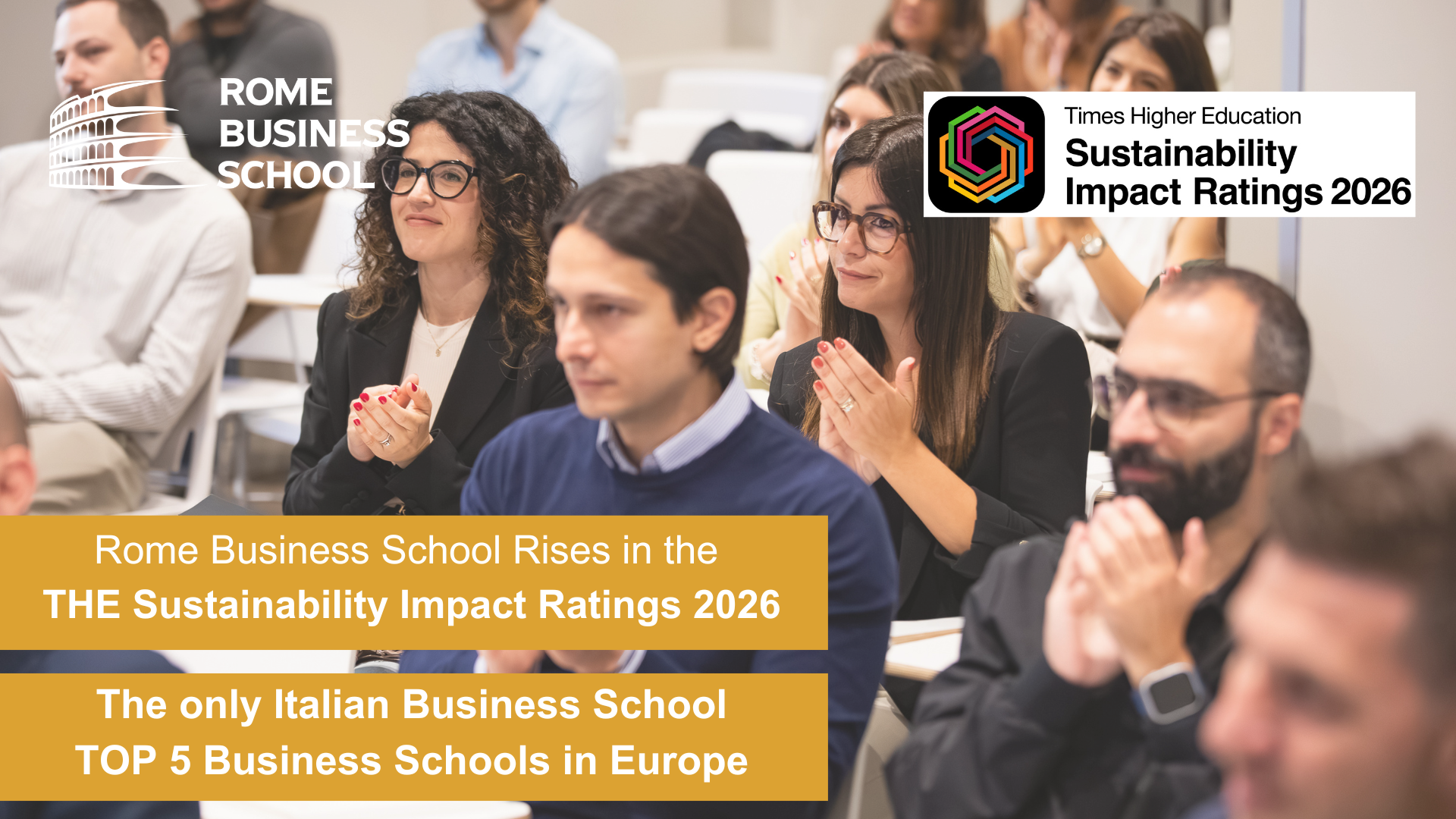
Rome Business School continues to strengthen its position in the THE Sustainability Impact Ratings 2026, ranking in the TOP 5 Business Schools in Europe and confirming its place as the only Italian business school in the Times Higher Education ranking, which measures the real impact of academic institutions in implementing the UN Sustainable Development Goals (SDGs).
The THE Sustainability Impact Ratings evaluates the commitment of academic institutions across 251 indicators. The final ranking combines results achieved on SDG 17: Partnerships for the Goals — the baseline indicator for every institution — with the three best performances across the other SDGs presented, rewarding a systemic approach to sustainable development. Compared to the previous edition, Rome Business School does not advance on a single isolated front, but broadly, improving across almost all monitored areas.
The largest leap concerns Quality Education (SDG 4), where the institution gains 500 positions. This is driven by an educational model that has made sustainability an integral part of every study programme, not an optional add-on — as demonstrated by the mandatory cross-cutting module on responsible leadership included in all master’s programmes, and the offering of specialist programmes such as the International Master in Energy Management, developed in partnership with Enel Green Power. Learning also extends beyond the campus through initiatives such as RBS Insights focused on the SDGs and company visits, including one to the FAO headquarters in Rome.
On Gender Equality (SDG 5), RBS advances by 400 positions: female students now represent 59% of the academic community, while women account for 68% of staff, promoting inclusivity and gender equality as drivers of business growth. To support this, RBS has introduced the Executive Women in Business Grant, which can cover up to 30% of the Master’s cost, to promote female career advancement. On the corporate training front, the partnership with Winning Women Institute aims to help companies build inclusive and innovative workplaces through training, workshops and events. Additionally, through its Research and Communication Centre, Rome Business School publishes an annual Gender Gap Report.
Reduced Inequalities (SDG 10) also rises by 400 positions, an advancement measured by RBS’s ability to build networks with the Third Sector and welcome a student community from over 107 nations. With Binario95, a multifunctional centre for homeless people, students, faculty and staff regularly participate in solidarity initiatives. With Save the Children Italia, through the Capstone Project framework, students periodically develop concrete retention and attraction strategies for the non-profit sector. With Fondazione Pangea Onlus, the institution supports the protection of fundamental rights in fragile contexts, with particular attention to women and children. Through meetings with organisations such as Save the Children, WFP, Amnesty International, IFAD and Greenpeace, students explore different approaches to sustainability, social impact and organisational transformation to apply in their careers.
Industry, Innovation and Infrastructure (SDG 9) also grows by 200 positions, driven by the institution’s ability to transform academic knowledge into concrete entrepreneurial initiatives. A prime example is the RBS4Entrepreneurship incubator: from 2021 to 2025, 25 startup ideas were developed and launched, with over 470 MVPs (Minimum Viable Products) created, generating more than 510 jobs. Currently, 47% of incubated startups are already active on the market with clients, confirming the programme’s ability to guide students from the ideation phase to concrete project validation. A particularly notable aspect is the strong female leadership within the programme: 73% of incubated startups have women entrepreneurs in leadership roles. The most represented sectors include Arts & Culture, Fashion, Tourism & Hospitality and Project Management.
Finally, the positioning on Partnerships for Global Goals (SDG 17) is confirmed, with Rome Business School continuing to invest through international research collaborations: from the partnership with RES4Africa Foundation on energy transition in emerging countries, to a study conducted with Spanish and Portuguese universities on the impact of cyberbullying on students’ psychosocial wellbeing.
“This recognition confirms a path that Rome Business School has been pursuing for years: integrating sustainability, inclusion, innovation and social responsibility at the heart of management education. Improving in the THE Impact Rankings does not simply mean moving up a ranking, but seeing concrete commitment to the United Nations Sustainable Development Goals and a vision of business education capable of generating value for students, companies and society recognised. Our mission, Better Managers for a Better World, stems precisely from this conviction: training competent, aware managers capable of contributing positively to change,” states Antonio Ragusa, Dean of Rome Business School.