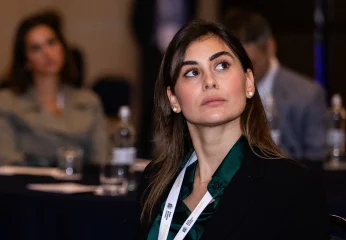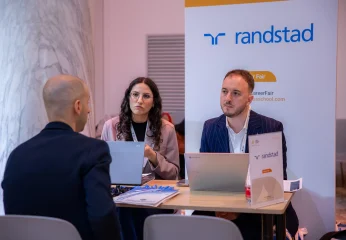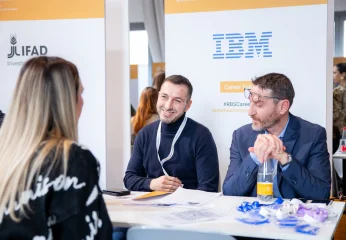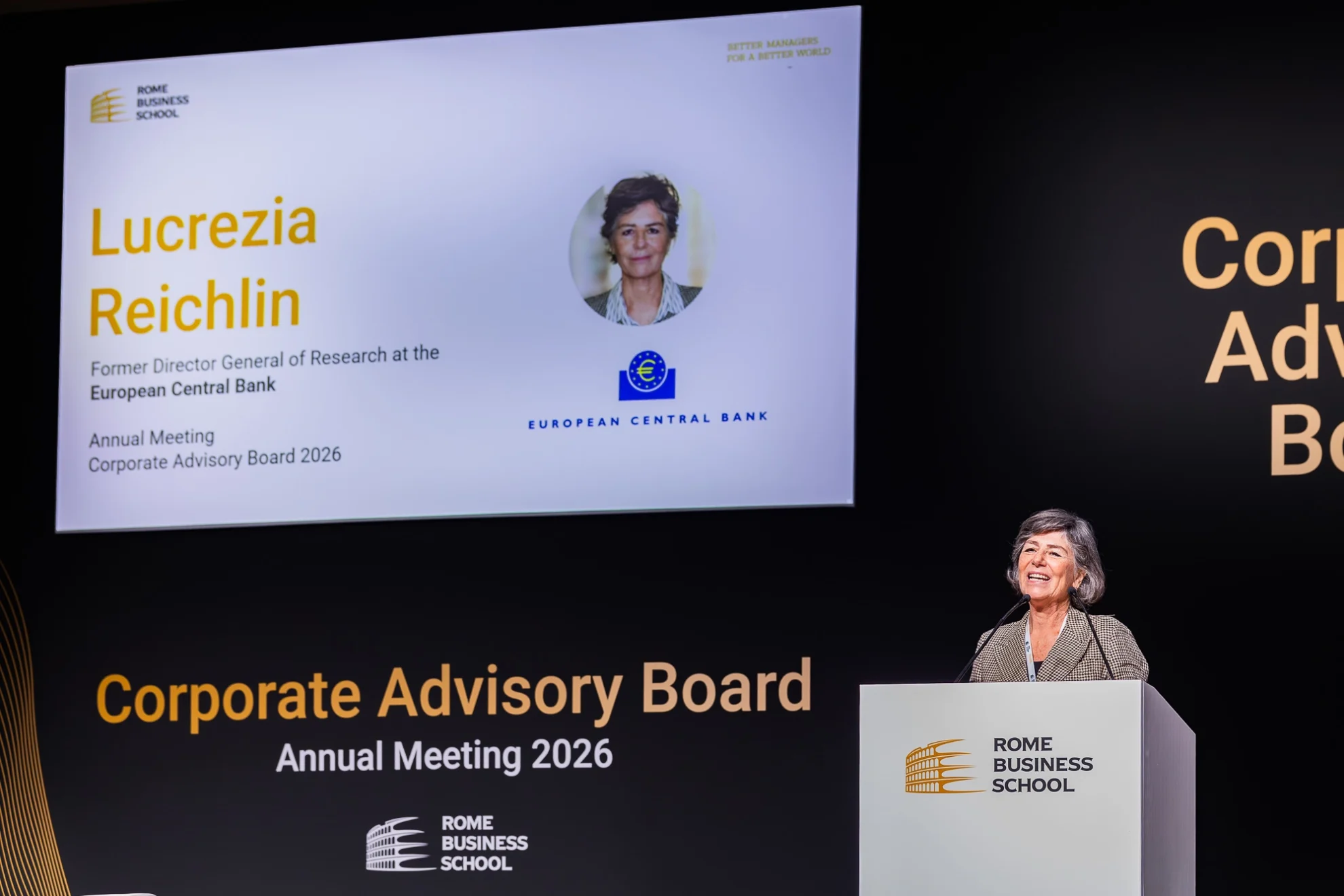
On May 21, 2026, the annual meeting of the Corporate Advisory Board (CAB) of Rome Business School took place at Rome Cavalieri, A Waldorf Astoria Hotel.
The strategic event brings together every year more than 100 managers, executives, and industry leaders from leading companies operating in Italy to discuss the major transformations shaping business, technology, economics, and management education.
The event was opened by Lucrezia Reichlin, internationally renowned economist and former Director General of Research at the European Central Bank (ECB), keynote speaker of the 2026 edition.
The Corporate Advisory Board of Rome Business School is a high-level advisory body that has supported the evolution of the school’s educational offering for the past seven years.
The Board integrates the perspective of CEOs, managers, and experts from 17 industries and 8 functional areas to help Rome Business School anticipate emerging trends, future skills, and market transformations.
Its mission is to create a concrete connection between academia and the corporate world through annual workshops, working groups, and discussions involving companies, faculty members, and international stakeholders.
Over the years, the CAB has hosted influential personalities such as Carlo Cottarelli, Umberto Galimberti, and Domenico De Masi.
Companies participating in the 2026 edition included Meta, Microsoft, Enel, Gucci, and Valentino.
During her speech, Lucrezia Reichlin analyzed the structural shocks reshaping global economic and geopolitical balances.
“Europe is redefining its role in a global order shaken by four structural shocks: geopolitical tensions, rising public debt — especially in the United States — the climate transition linked to energy security, and global imbalances driven by China’s trade surplus,” Reichlin stated.
She also highlighted how global transformations are reshaping the international economic system:
“Three decades of rapid growth in China, India, and the Global South have redesigned global income maps. The era of uncontested American dominance is ending, and the resulting vacuum is being filled by regional rivalries, proxy conflicts, and the return of open warfare.”
A significant part of the discussion focused on the impact of artificial intelligence and the energy transition on future business models.
“Artificial intelligence is accelerating energy demand at an unprecedented pace. The challenge ahead is no longer only sustainability, but balancing innovation, energy resilience, and diversification in a rapidly evolving geopolitical environment,” Reichlin added.
During the meeting, participants presented the outcomes of the seven annual workshops organized by the Corporate Advisory Board across Rome and Milan.
The workshops were hosted in collaboration with companies such as Red Bull Italia, Heineken Italia, and Gruppo FS Italiane.
The working groups focused on strategic topics including:
Among the main insights that emerged from the workshops was the growing role of Agentic AI in business processes and the need for stronger governance, proprietary data, and new transversal skills.
In this evolving landscape, future leaders are increasingly becoming orchestrators of people, processes, and technologies, while cultural fit is becoming as important as role fit in the future job market.
Federica Salvatori, Associate Dean of Rome Business School, emphasized the strategic importance of collaboration between universities and companies.
“CAB Day 2026 confirmed that dialogue between academia and business is not an addition to education, but its driving force. We are proud to create opportunities for discussion among international companies, leading economists, and our faculty members to contribute together to Italy’s growth.”
The Corporate Advisory Board is one of the key tools through which Rome Business School develops educational programs closely aligned with the needs of the global market.
Through annual workshops, networking opportunities, and collaboration with international top managers, the CAB helps train professionals capable of facing the challenges of modern business and leading change