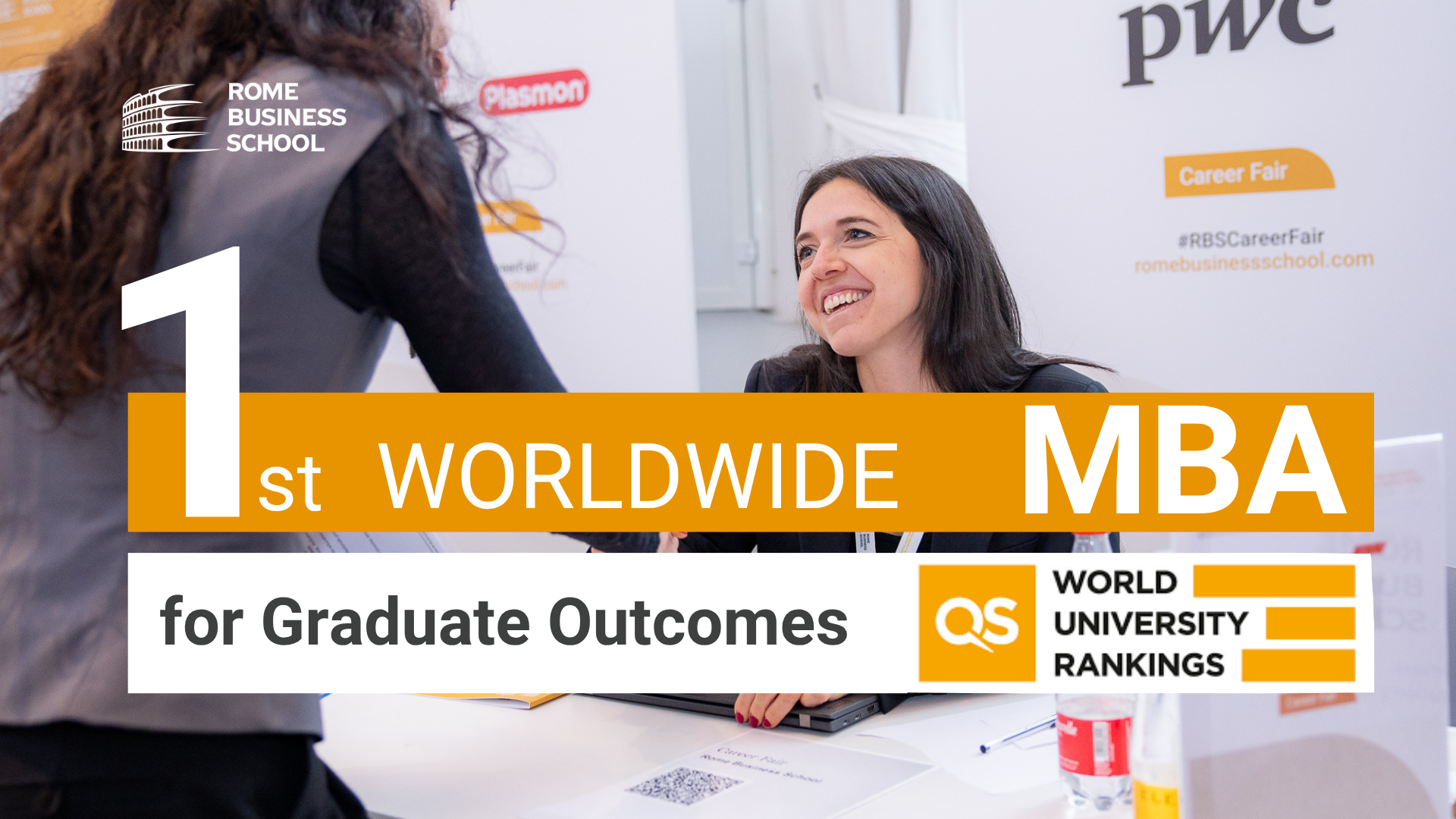
Rome, Wednesday, 14 October 2026. Rome Business School has once again secured 1st place worldwide for graduate employment outcomes in the QS International Trade Rankings 2027, marking its second consecutive year at the top of the category. The School’s MBA also ranks 9th worldwide for innovative teaching, entering the global Top 10, and 14th for international trade curriculum content. In the overall ranking, the programme places 38th out of 110 programmes assessed, securing a position in the global Top 40.
Developed by QS Quacquarelli Symonds in partnership with the Hinrich Foundation, the QS International Trade Rankings assess MBA and Master’s programmes according to their ability to prepare professionals for international markets and the challenges of global trade.
For the second consecutive year, Rome Business School’s MBA ranks first worldwide in the graduate employment outcomes category. The achievement highlights the School’s focus on a central objective of management education: translating the knowledge and skills acquired during a programme into tangible career opportunities.
The MBA scores 100/100 for career support and 95.2/100 for graduate employment rate. The indicator considers both graduates’ employment outcomes and the support provided by institutions in helping students transition from education to the job market.
Rome Business School’s Career & Entrepreneurship Center supports students throughout their learning journey through personalised career guidance, mentoring, networking opportunities, meetings with companies and professionals, and activities designed to prepare them for the job market.
This approach aims to develop not only technical and managerial skills, but also the ability to position oneself professionally and navigate increasingly complex and evolving international environments.
One of the most significant achievements in the QS International Trade Rankings 2027 is Rome Business School’s progress in innovative teaching. The MBA climbs from 12th to 9th place worldwide, entering the global Top 10.
The programme scores 100/100 for internships and 86.5/100 for experiential learning, highlighting the importance of practical application and direct engagement with the business world.
At the core of the educational model is the Circular Learning methodology, an approach inspired by EFMD standards that combines interactive lectures, business cases, management simulations, teamwork, continuous feedback and the practical application of skills.
A central component of this approach is the Practice Lab, where students collaborate with managers from national and international companies on professional challenges, practical exercises and real-world business cases.
The learning experience is further enriched by business simulations, company visits, leadership activities, individual coaching and applied projects. These activities aim to bring the educational experience closer to the decision-making processes and operational challenges faced by managers in their daily work.
Rome Business School’s MBA also ranks 14th worldwide for international trade curriculum content, one of the key indicators in the QS International Trade Rankings methodology, accounting for 30% of the overall score.
The assessment covers six key areas:
The MBA develops these competencies through an interdisciplinary curriculum integrating international management, finance, operations and sustainable value chain management, cross-cultural leadership, innovation, data analytics, artificial intelligence and emerging technologies.
The objective is to prepare professionals to understand global market transformations, manage complex organisations and contribute to business strategy in international environments.
The results achieved in the QS International Trade Rankings 2027 reflect an educational model that combines academic preparation, practical experience and strong connections with the business world.
Through applied activities, corporate projects, simulations and professional development initiatives, Rome Business School’s MBA aims to deliver learning experiences aligned with organisational needs and the skills required in today’s markets.
The integration of learning, networking and career development is a distinctive element of the programme, designed to help students define their professional goals and develop their career paths.
“Employment outcomes are the most important indicator. Ranking first worldwide for graduate employment outcomes for the second consecutive year demonstrates that education can have a tangible impact on professional careers. Our position in the global Top 10 for innovative teaching and 14th place for international trade curriculum content confirm the strength of a model that combines quality, practical experience and connections with businesses,” comments Antonio Ragusa, Dean of Rome Business School.
The results of the QS International Trade Rankings 2027 further strengthen Rome Business School’s international profile and reflect its commitment to management education focused on quality, internationalisation and graduate employability.
The School’s presence across major international management education ranking systems, including Bloomberg Businessweek, QS Rankings, Times Higher Education and Eduniversal, forms part of its broader commitment to strengthening the connection between education, business and professional development.
First place worldwide for graduate employment outcomes, entry into the global Top 10 for innovative teaching and 14th place for international trade curriculum content reinforce Rome Business School MBA’s position among international programmes focused on combining managerial expertise, practical experience and preparation for the challenges of global business.