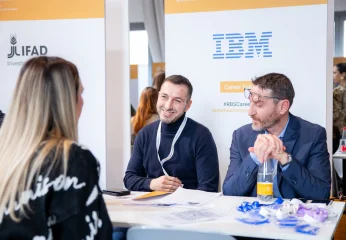
Sustainability is no longer just about communicating commitments. It is about embedding sustainability into business decisions and creating long-term value. This was the key message of a session led by Diego Miluzzi, Senior Consultant at EY, at Rome Business School, focusing on stakeholder engagement and double materiality as drivers of sustainable business impact.
The session explored how companies can integrate sustainability into their strategies, strengthen relationships with stakeholders, and make more informed decisions. The discussion was part of a broader reflection on UN Sustainable Development Goal 17 (SDG 17) – Partnerships for the Goals, highlighting the importance of collaboration in addressing global challenges and building more responsible business models.
The session opened with an overview of sustainable development and its relevance to today’s business environment. Sustainability can no longer be treated as a reputational exercise or a standalone initiative. Instead, it must be integrated into business strategies and operations to help companies respond to market changes, meet societal expectations, and strengthen their long-term competitiveness.
In this context, the United Nations Sustainable Development Goals (SDGs) provide a shared framework for connecting business priorities with global challenges. Particular attention was given to SDG 17, which emphasizes the role of partnerships in achieving sustainable development.
A key theme of the session was the role of collaboration in turning sustainability ambitions into practical action. SDG 17 highlights the importance of multi-stakeholder partnerships, reliable data, policy alignment, monitoring, and accountability.
For businesses, this means that engaging with stakeholders is not simply an additional activity. It is an opportunity to understand the real and potential impacts of business operations, build trust, and develop stronger relationships with the people and organizations affected by corporate decisions.
Effective stakeholder engagement can therefore support better decision-making, improve transparency, and strengthen the credibility of sustainability reporting.
One of the most practical aspects of the session focused on stakeholder engagement: a structured, ongoing dialogue that enables companies to understand the interests, expectations, and concerns of the people and groups connected to their activities.
This process goes beyond one-off consultations. It involves identifying and prioritizing stakeholders, defining engagement objectives, selecting appropriate methods, gathering feedback, and integrating the results into business strategy and materiality assessments.
Companies can use different approaches, including surveys, interviews, focus groups, and workshops, to collect insights and better understand stakeholder expectations. These activities may involve employees, customers, suppliers, financial institutions, business partners, public authorities, trade unions, local communities, media, and nonprofit organizations.
The key takeaway is that stakeholder engagement should be an ongoing process rather than a one-time exercise. By listening to different perspectives, companies can gain a clearer understanding of their impacts, risks, and opportunities.
The session then explored sustainability reporting and its role in helping companies communicate their environmental, social, and governance (ESG) performance.
A sustainability report is more than a document outlining corporate commitments and initiatives. It can also help organizations improve internal awareness, define performance indicators, and establish clearer objectives.
A central concept in this process is double materiality, which considers sustainability from two complementary perspectives.
By considering both dimensions, companies can develop a more comprehensive understanding of sustainability and its implications for business strategy. This approach helps connect corporate responsibility with risk management, financial performance, and long-term value creation.
Diego Miluzzi also introduced the European sustainability reporting framework, including the European Sustainability Reporting Standards (ESRS), developed by EFRAG and adopted by the European Commission.
These standards cover cross-cutting and topical sustainability issues across environmental, social, and governance areas. They address matters such as policies, actions, targets, metrics, and the management of impacts, risks, and opportunities.
This evolving landscape highlights an important shift: sustainability is no longer the responsibility of a single department. It requires a combination of strategic thinking, data analysis, stakeholder engagement, risk management, governance, and transparent communication.
For future managers, understanding these processes means developing skills that are increasingly relevant in organizations expected to demonstrate not only what they achieve, but also how they create value and affect the world around them.
Through examples from corporate sustainability reports and practical case studies, the session demonstrated how stakeholder engagement and double materiality can help companies make sustainability a concrete part of their decision-making processes.
The objective is not simply to produce more complex reports. It is to build a consistent approach that connects business strategy with impacts, risks, opportunities, and stakeholder expectations.
For Rome Business School students, the session with EY offered valuable insight into the practical side of sustainability consulting and ESG reporting. It also highlighted why collaboration, transparency, and materiality are becoming increasingly important for effective business leadership.
As companies, investors, institutions, and communities call for greater accountability, the ability to listen to stakeholders and understand sustainability-related risks and opportunities is becoming a valuable management skill—and an essential part of creating lasting business value.