Artificial intelligence is not only changing the way companies automate processes, analyze data, or generate content. It is entering a much more delicate space: emotions, customer relationships, and trust.
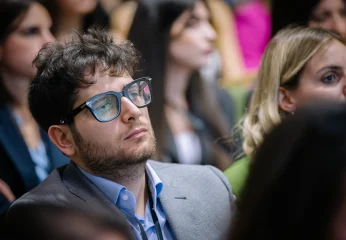
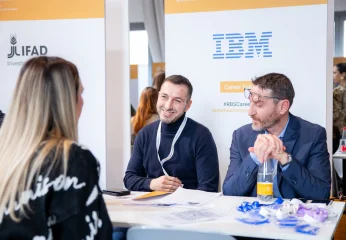
This was the focus of “Emotional Marketing in the Era of Empathic AI Agents,” the latest event in the RBS Innovation Bites series, designed for students and alumni of Rome Business School.
The discussion was led by Valentino Megale, Program Director of the International Master in Artificial Intelligence at Rome Business School, and Massimo Canducci, Chief AI Officer & Innovation and Strategy Director at Spindox.
At the heart of the conversation was a crucial question for modern marketing: what happens when AI agents begin to recognize emotional signals, adapt their language, modulate their tone of voice, and create increasingly personalized interactions?
The starting point of the discussion was the shift from a purely functional understanding of AI toward a more relational dimension.
AI agents are no longer limited to responding to a request. They can interpret elements of human behavior, detect signals from voice, facial expressions, or the pace of an interaction, and adapt their responses accordingly.
This is where emotional marketing takes on a new meaning.
It is no longer simply about segmenting audiences or personalizing messages based on demographic or behavioral data. The new frontier lies in the ability of AI systems to adapt in real time to a user’s emotional state, selecting words, timing, pauses, and response styles designed to make the interaction more effective.
Canducci described this evolution as a continuous cycle: the agent observes, interprets, responds, and then adjusts its response based on the user’s reaction.
This ongoing feedback loop is what distinguishes emerging AI-powered interactions from more traditional forms of digital communication.
The most sensitive issue raised during the event concerned ethics.
If a system recognizes that a person is anxious and slows down the conversation to help them better understand information, this can be considered a service.
But if the system maintains or intensifies that emotional state in order to influence a purchasing decision, the situation changes fundamentally.
This is where emotional marketing meets a critical managerial question: what is the purpose of the emotion the system is detecting? Is it being used to improve the user experience, or to influence behavior in a way that is not transparent?
The difference is not technological, but rather strategic and intentional.
The discussion therefore highlighted a central principle: the quality of AI does not depend only on how well it performs, but also on the purpose for which it is designed.
An empathic AI agent can reduce frustration, improve customer support, and make services more accessible. However, it can also become a tool for pressure, dependency, or manipulation if its primary goal is to retain users, maximize engagement, or drive conversions at any cost.
Another important point concerned the distinction between reliability and trust.
A machine can be reliable because it always responds, remembers previous conversations, is available 24/7, and communicates in the user’s language.
Trust, however, is something different. It involves vulnerability, responsibility, and judgment.
Canducci drew attention to precisely this limitation. AI can simulate empathy, but it does not have the same moral responsibility as a human being. It can follow a procedure, but it cannot assume the human weight of an exception.
And it is often precisely the exception—the unexpected gesture, the unplanned action, the decision made by someone who chooses to go beyond the standard—that creates genuine trust between a customer and an organization.
For this reason, companies integrating empathic AI agents into marketing, customer service, or sales processes need to establish clear principles: disclose when users are interacting with a machine, explain the system’s limitations, avoid creating emotional dependency, and provide pathways to human operators in more sensitive situations.
In the short term, systems designed to keep users engaged may increase engagement metrics.
But the issue raised during the event goes deeper: what works in the short term can damage relationships in the long term.
When people feel that they have been emotionally manipulated, the damage is not merely commercial. It becomes personal.
And precisely because emotional marketing operates within intimate dimensions of the customer relationship, the reputational risk for a brand can be significantly greater than that associated with other forms of ineffective or intrusive communication.
From this perspective, AI does not reduce corporate responsibility—it amplifies it.
Every design choice, optimization metric, and automated conversation contributes to defining the type of relationship a brand wants to build with its audience.
For Rome Business School students and alumni, the discussion provided a practical perspective on a transformation affecting marketing, innovation, customer experience, ethics, and leadership.
Empathic AI is not simply an emerging technology. It is a test of what kind of managers and marketing professionals organizations will need in the years ahead.
The message emerging from RBS Innovation Bites is clear: the future of marketing will not be determined solely by the ability to use intelligent tools, but by the ability to govern them responsibly.
In a context where machines can simulate listening, attention, and empathy, competitive advantage will increasingly depend on transparency, responsibility, and the quality of human decisions behind the technology.