What does it take to turn a passion for travel into a global business? And what kind of career opportunities can a travel company offer beyond organising trips?
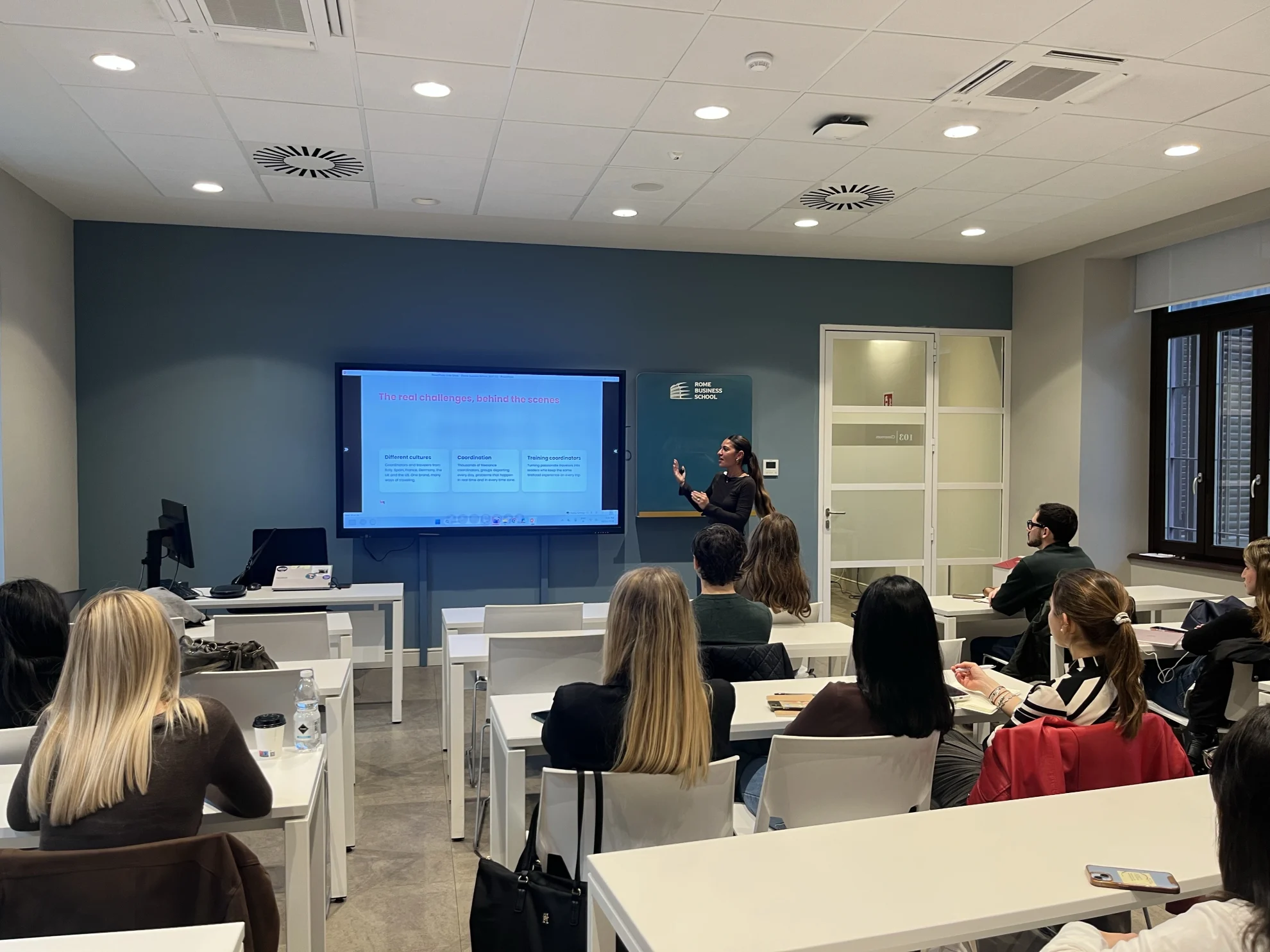
On November 11, Rome Business School welcomed Giusy Bruno, Global Community Recruitment Manager and Global A&C Acquisition Lead at WeRoad, for an inspiring Company Visit. The meeting gave our international Master’s students an inside look at one of the fastest-growing travel communities and a chance to discover the people, strategies and business functions behind its success.
More importantly, it challenged a common assumption: working in tourism does not necessarily mean planning holidays or leading groups. There are many different ways to build a career in this industry.
WeRoad started with a simple idea: people want to explore the world, but they also want to meet others who share their interests and stage of life.
The story began in 2016, when founders Paolo De Natali and Fabio recognised an opportunity in the travel market. They saw a gap between traditional holidays and the desire of millennials and young professionals to travel together, make connections and share experiences.
They turned this insight into a business. In March 2017, they launched the WeRoad website. Just a few months later, the first trip to Cuba marked the beginning of the company’s journey.
By October 2017, the first traveller had already booked a second trip. This early sign of customer loyalty showed that WeRoad was building something bigger than a travel service: a community.
The company continued to grow, even after the disruption caused by the pandemic in 2020. The real acceleration came between 2021 and 2022, as travel demand returned and the business expanded internationally.
The numbers tell the story:
From a small start-up to an international business, WeRoad has built its growth around a clear understanding of its audience and a strong community-based model.
One of the most interesting insights came from Giusy Bruno’s explanation of her role.
As Global Community Recruitment Manager and Global A&C Acquisition Lead, she develops the strategy for finding and selecting the people who lead WeRoad trips. She also manages a team of around 50 people across different markets.
The scale of this activity is impressive: WeRoad receives more than 5,000 applications every year from people interested in becoming travel coordinators.
But there is an important distinction. Her role does not involve planning trips, acting as an international relations officer or managing traditional B2B partnerships. Instead, she focuses on building and developing the global community of people who make the travel experience possible.
This is a great example of how diverse careers in tourism can be.
You can work in the travel industry without being a tour guide or organising holidays.
WeRoad also needs professionals in marketing, graphic design, community management, software engineering, recruitment, finance and many other fields. The company brings together different skills to create a consistent experience for its customers and community.
For international Master’s students, this opens up an important perspective: your degree does not have to match the tourism sector to help you build a career in it.
WeRoad is more than an online tour operator. It is a community-based business that connects people, cultures and stories through shared experiences.
During the presentation, Giusy explained the three main groups that shape this ecosystem:
The community also stays connected between trips. WeRoad organises community meet-ups in more than 40 cities, bringing travellers together even when they are not on the road.
This model creates a strong connection between customers, coordinators and employees. Everyone contributes to the same experience.
A travel experience may look simple from the customer’s perspective. You choose a destination, book a trip and get ready to leave.
Behind that experience, however, several teams work together every day.
Giusy introduced the main departments at WeRoad and showed students how different professional functions contribute to the business:
This overview highlighted an important point: a global travel company needs much more than people who love travelling. It needs professionals with different backgrounds, from technology and business to communication, operations and people management.
The visit also included an interactive exercise that brought the business challenges to life.
Giusy asked the students to imagine they were leading the WeRoad Community Team.
With thousands of travel coordinators, hundreds of destinations and groups travelling every day, what would keep them up at night?
Students shared their ideas. Some focused on supporting coordinators, ensuring effective communication across different channels and keeping schedules on track. Others highlighted the importance of responding to geopolitical developments that could affect travel plans.
The discussion revealed the real complexity of managing an international community.
WeRoad operates across different markets, including Italy, the UK, Spain, Germany and the US. Each market brings different cultures, expectations and ways of communicating.
The key challenges include:
The exercise showed students that management in an international company requires flexibility, empathy, organisation and strong problem-solving skills.
Beyond its business model, WeRoad places people at the centre of its identity.
During the visit, Giusy introduced the company’s mission, vision and core values. Respect, Sharing, Daring, Discovery, Passion and Wowness guide the way the company approaches travel, relationships and its community.
Students also explored practical examples of the WeRoad manifestos for travellers and coordinators.
These manifestos help communicate what the company expects from its community and the kind of experience it wants to create. They turn values into everyday behaviours and shared responsibilities.
WeRoad also invests in its internal ecosystem through initiatives such as Global Reunions, Bootcamps and community gatherings.
WeRoad’s business model continues to evolve.
In 2017, the company started as an online tour operator. Over the years, it developed a more structured international operation and expanded its offer.
In 2025, the launch of the WeMeet app introduced another way for the community to stay connected between trips.
Looking ahead to 2026, the company is continuing to develop its community and ambassador ecosystem. Community members and ambassadors can help design trips and events, engage audiences and earn through the seats they sell.
The company is also broadening the experiences it offers. Its journeys now go beyond traditional travel categories and explore different interests, including:
This evolution shows how a travel brand can grow by building relationships and experiences around people’s interests, rather than focusing only on destinations.
The final part of the Company Visit focused on an especially relevant topic for our Master’s students: career opportunities.
Giusy introduced WeRoad’s career opportunities and internship possibilities through the company’s careers platform.
One student’s question captured a common concern among international graduates:
“What kind of position can I apply for with a degree in Arts and Culture?”
The answer was clear: potentially any position that matches your skills and what you can bring to the company.
WeRoad does not focus exclusively on academic backgrounds. It looks at people’s potential, capabilities, experience and contribution.
This is an important message for students entering the international job market. Your degree is part of your profile, but it does not have to define your entire career path.
A background in Arts and Culture, for example, can develop valuable skills in communication, creativity, research, cultural awareness and project management. These skills can be relevant across different departments and industries.
Students interested in joining WeRoad can explore opportunities through the company’s careers website.
The WeRoad Company Visit offered Rome Business School students much more than an overview of a successful travel company.
It provided a practical look at how an international business grows, how different departments collaborate and how a community becomes a core part of a company’s strategy.
For students looking to enter the job market, one takeaway stood out: do not limit your career ambitions to the job titles or industries that seem directly connected to your degree.
Sometimes, the most interesting opportunities emerge where your skills meet an unexpected industry.
And as WeRoad’s story demonstrates, a passion for travel can be just the starting point of a much bigger professional journey.