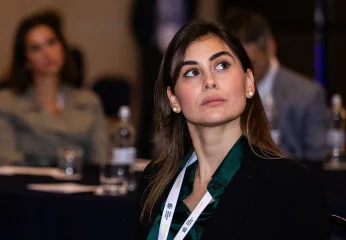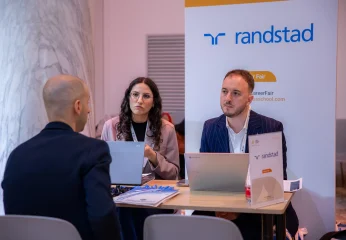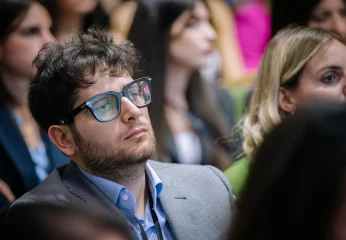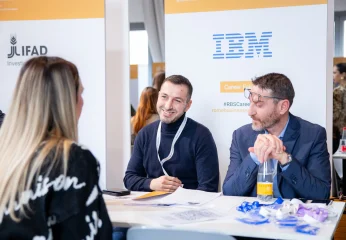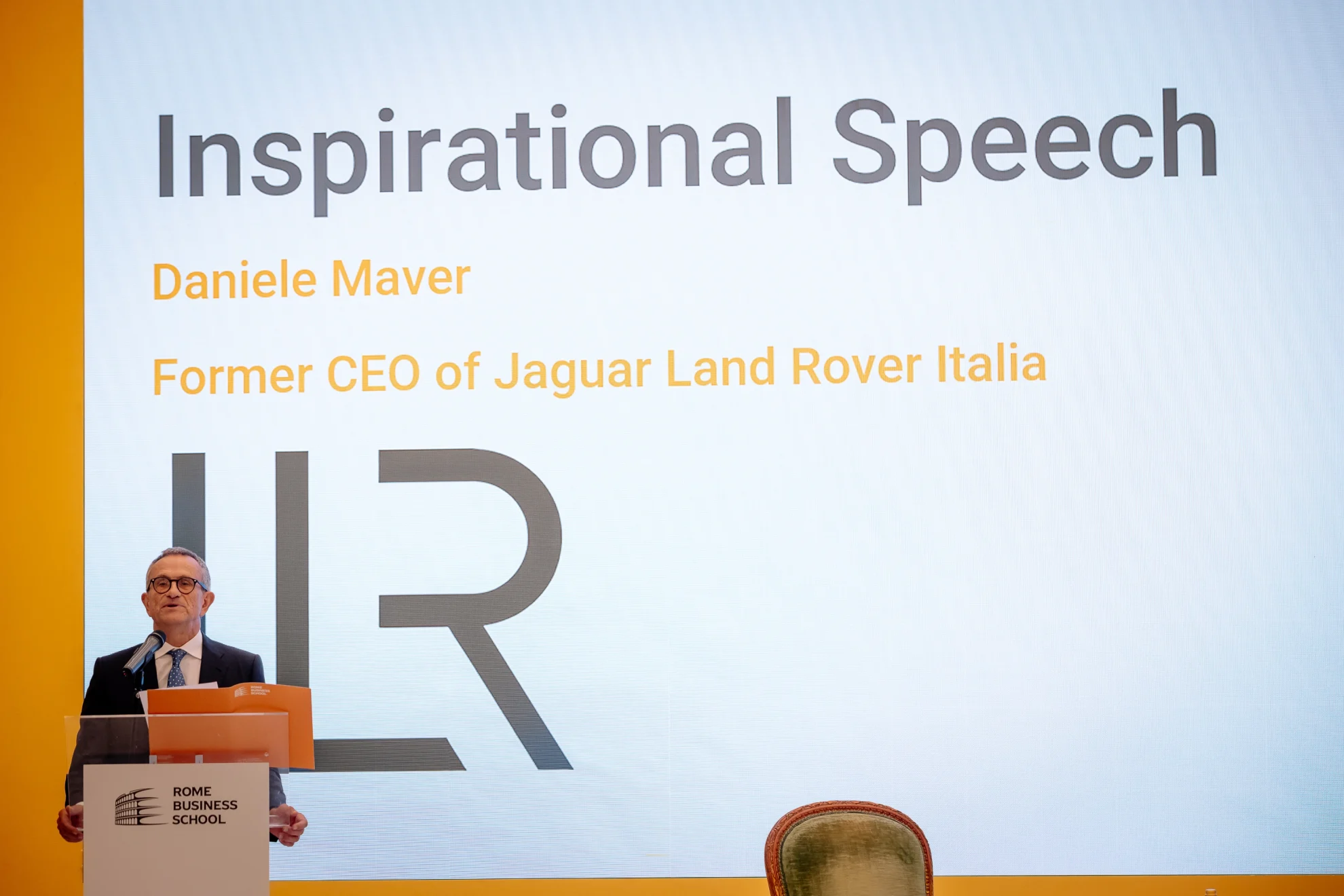
Daniele Maver, Former President and CEO of Jaguar Land Rover Italia, joined Rome Business School’s Global and International Welcome Event as guest speaker for the October Intake 2026. In his Opening Speech, he encouraged students to look beyond academic qualifications, embrace new perspectives and prepare for the challenges reshaping the business world.
What does it take to become a leader in a world that never stops changing? For Daniele Maver, Former President and CEO of Jaguar Land Rover Italia and guest speaker at Rome Business School’s Global and International Welcome Event, it starts with:
Learning how to navigate what you do not know.
This was one of the key messages of his Opening Speech to the October Intake 2026 students during Welcome Week. His advice was clear:
A Master’s degree should be more than another qualification on your CV. It is an opportunity to challenge your way of thinking, discover new possibilities and shape your professional future.
During his speech, Maver reflected on his own professional journey and the impact of his MBA experience at Bocconi University in Milan more than four decades ago.
Beyond the knowledge, analytical tools and management methodologies he acquired, the programme exposed him to different industries, new ways of thinking and people whose experiences challenged his own perspectives.
But one lesson proved particularly valuable: learning how to manage what you do not know.
By analysing business cases across different sectors and discussing unfamiliar situations, Maver developed a method for approaching new and complex problems. It was a skill that would prove valuable throughout his professional career.
His message to students was straightforward:
do not treat your Master’s degree as something you simply need to complete to earn a qualification. Use it to challenge your assumptions, broaden your horizons and perhaps change the direction of your career.
Professional growth, Maver explained, cannot be separated from an understanding of the world around us. Today’s students are preparing to enter a world undergoing profound transformations, with consequences for businesses, institutions and society.
Drawing on the ideas of historian Yuval Noah Harari, author of Sapiens and Homo Deus, the guest speaker highlighted three major challenges facing humanity: ecological collapse, technological disruption driven by artificial intelligence and global conflict.
Understanding these forces is essential for future professionals who will need to make decisions in increasingly complex environments, combining technical expertise with analytical thinking, strategic vision and a sense of responsibility.
Climate change is no longer a distant concern. Its effects are already influencing economies and organisations, affecting supply chains, investment decisions, resource availability, operating costs and business strategies.
As highlighted during the Opening Speech, sustainability is not an issue reserved for environmental specialists. It is a strategic priority for professionals across finance, fashion, food and beverage, technology, culture and management.
For tomorrow’s leaders, the challenge will be to understand how environmental factors shape business decisions and contribute to building more resilient and responsible organisations.
Artificial intelligence is already transforming how we work, conduct research, develop products and interact with customers. Its applications create significant opportunities for innovation and productivity, while also raising questions about the future of work, the concentration of economic power and society’s ability to govern rapidly evolving technologies.
Maver drew attention to the importance of understanding not only AI’s potential, but also the risks that may accompany its development.
For future managers, adopting new technologies will not be enough. They will need to evaluate them critically, understand their implications and use them responsibly.
In a business environment where technology can evolve faster than the rules and institutions designed to govern it, the ability to keep learning becomes a competitive advantage.
Maver’s message goes beyond individual technologies or economic transformations. It encourages students to develop an approach that will support them throughout their careers: curiosity, open-mindedness and the ability to tackle problems without immediate or obvious answers.
The world of work they will enter may look very different from today’s. New business models, technological breakthroughs and global challenges will require professionals who can adapt, question their existing knowledge and continuously learn.
This is where the value of a Master’s degree can extend beyond the knowledge acquired in the classroom. It offers an environment in which students can engage with international perspectives, explore new approaches and prepare for increasingly complex decisions.
Rome Business School’s Global and International Welcome Event marks the beginning of a new journey for its students. Daniele Maver’s Opening Speech offered a practical perspective on what it means to prepare for the future: not having every answer, but developing the skills to ask the right questions and navigate uncertainty.
The takeaway is simple: do not limit yourself to learning what you already know. Explore, challenge yourself and engage with people who see the world differently.
Because professional growth is not just about knowing more. It is also about learning how to navigate what you have yet to discover.