Professor Alberto Sangiovanni Vincentelli, co-founder of Cadence and Synopsys and one of the leading figures behind semiconductor design automation, took center stage in a debate on the relationship between humanity and artificial intelligence during the XXIV ASFOR Management Education Conference. The event took place on June 17–18 and was hosted for the first time at the Rome Business School campus.
The conference theme, HUMANAI, captured the key challenge discussed throughout the two-day event: artificial intelligence is reshaping not only what management education teaches, but also how it is taught. Teaching methods, learning processes, assessment systems, and the relationship between educators and learners are all evolving.
The conference opened with remarks from ASFOR President Marco Vergeat and Rome Business School Dean Antonio Ragusa. Both highlighted a central question: if AI is changing how organizations make decisions, learn, and operate, how should management education respond?
“Artificial intelligence is deeply transforming the mindset and skills required of managers and professionals,” said Marco Vergeat. “Management education must do more than provide new competencies. It must rethink learning processes and create space for critical thinking, human values, motivation, and personal growth.”
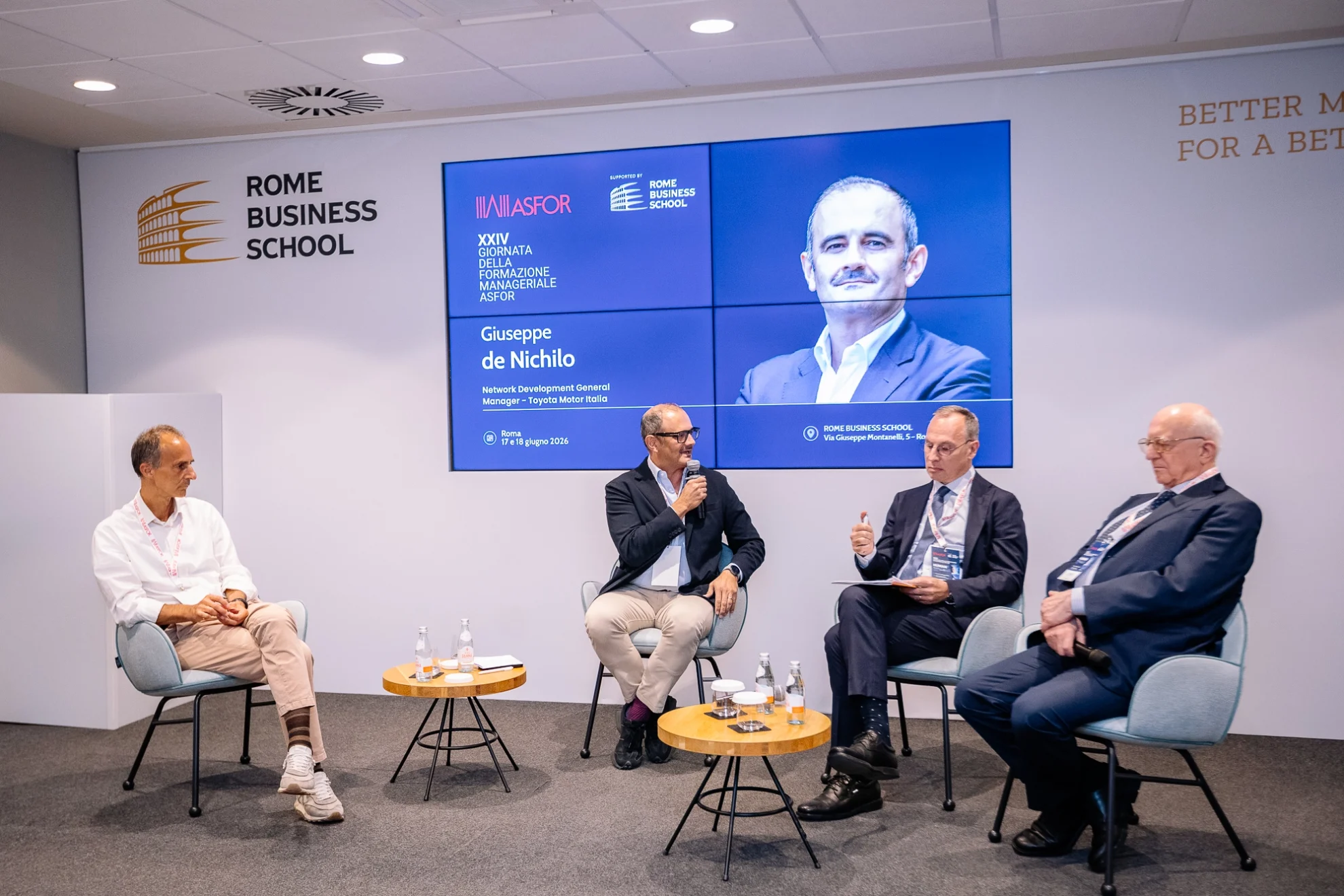
The opening session focused on the future profile of managers and leaders. The discussion was moderated by Professor Elio Borgonovi, Professor Emeritus at Bocconi University.
Panelists included Duccio Vitali, CEO of Alkemy Group; Giuseppe De Nichilo, Network Development General Manager at Toyota Motor Italia; and Antonio Ragusa, Dean of Rome Business School.
“Companies are now recognized as social actors as well as economic actors,” said Borgonovi. “Today, this relationship is increasingly shaped by digital technologies and artificial intelligence. Businesses are leading the adoption of these tools, which are transforming business models and stakeholder relationships. To create a positive impact on society, organizations need a gradual, experimental, and responsible approach.”
The first day concluded with a networking event in the Rome Business School garden, followed by a conversation with Italian journalist and author Massimo Franco, who presented his latest book on the relationship between the United States and the Vatican.
The conference continued with two roundtable discussions dedicated to the future of learning and development.
The first session, coordinated by ASFOR Vice President Elisabetta Salvati, explored the broader implications of change. Speakers included Giorgio Colombo, Executive Vice President Human Resources and ICT at Edison; Francesco Venier, Dean for Executive Education at MIB Trieste School of Management; and Lucia Melcore, HR Director Equality & Inclusion Europe at Procter & Gamble.
“The discussion highlighted a crucial issue,” said Salvati. “Change requires more than acquiring new skills. It challenges us to rethink how we define competence, leadership, and value. As it becomes easier to generate content and analyses, the real differentiator remains the ability to turn knowledge into action and results.”
The second session, moderated by Massimo Scarcello, Associate Dean for Corporate Education and Institutional Relations at Rome Business School, focused on the practical transformation of learning processes.
Participants included Valentino Megale, CEO and Co-Founder of Softcare Studios; Katiuscha Gabriele, Head of Academy at FiberCop; and Ruggero Cesaria, Learning Ecosystems, AI Projects & Global Planning at Stellantis.
“The discussion revealed a shared awareness,” said Scarcello. “Artificial intelligence is accelerating profound changes in learning models. However, the real challenge is not only technological. It is also organizational, cultural, and managerial.”
One of the highlights of the conference was the keynote conversation with Professor Alberto Sangiovanni Vincentelli, Professor of Electrical Engineering and Computer Sciences at the University of California, Berkeley.
Recognized as one of the pioneers of semiconductor design automation, Sangiovanni Vincentelli co-founded Cadence and Synopsys, two companies that continue to shape the global semiconductor industry.
During the session, titled “More Humanity in the Age of AI,” he emphasized the importance of understanding the foundations behind technological innovation.
“Artificial intelligence does not always provide the right solution,” he said. “Science remains fundamental. Critical thinking is essential whenever we use technologies whose internal mechanisms we do not fully understand. We must focus on principles, not only on tools. To face the AI challenge, people need to understand its foundations, not simply learn how to write prompts.”
At the end of the session, ASFOR presented him with the ASFOR Award for Excellence 2026, the organization’s highest recognition for individuals who have made an outstanding contribution to management culture and innovation.
Reflecting on education, Sangiovanni Vincentelli stressed the importance of combining technical and humanistic knowledge.
“Too often we teach people how to use tools without understanding them. Innovation does not come only from scientific disciplines. To develop a broader vision, we should integrate the humanities. Some of my own achievements were inspired by classical philosophy, including Plato, Saint Augustine, and Kant. Scientific discoveries can also be elegant because they explain reality in a simple and universal way. Today’s AI systems often achieve results through brute force rather than elegance.”
Closing the event, Antonio Ragusa highlighted the broader significance of the discussions.
“These two days reminded us that the AI challenge is not only technological. It is deeply cultural and educational. Management education has the responsibility to prepare leaders who can understand and use AI while preserving critical thinking, ethical judgment, and a human-centered perspective. Hosting this important dialogue alongside ASFOR and Professor Alberto Sangiovanni Vincentelli allowed Rome Business School to contribute to a vision of management education that combines innovation, responsibility, and humanity.”