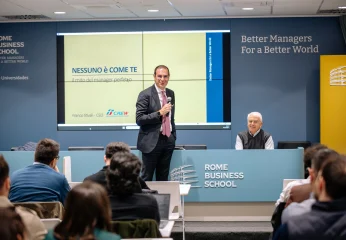
The failure of many startups can be traced back to an identity crisis. Without a defined direction, management falls into reactive decision-making. Furthermore, employees lose engagement when purpose is lacking. At Rome Business School, we teach that leadership begins with the “why.” Therefore, it is about moving from “what we do” to “who we are.” This concept is explored in our Bachelor Degree in Business Administration, where students learn the foundations of market positioning.
A Mission Statement is a pragmatic declaration of intent. It defines the organization’s “playing field” today. Specifically, it describes the core business and the target market. If strategy answers “How will we win?”, the mission answers “What are we doing now?”. Because of this, it serves as a roadmap for daily operations.
An effective mission must be operational and grounded. For this reason, it should specify the philosophy that guides the process. It serves as the social contract between the company and its partners. This operational clarity is a cornerstone of our International MBA. As a result, our students are prepared to steer global organizations with precision.
A well-crafted mission guides daily operations while allowing for growth. Instead of focusing on generic excellence, these examples show unique contributions. For instance:
The Vision Statement is the future scenario the organization commits to creating. It is an act of economic imagination. Therefore, if the mission is the engine, the vision is the horizon. A powerful vision does not talk about revenue. Instead, it talks about systemic change.
The psychological value of a Vision is immense. For example, it maintains the course during cyclical crises. When the market shifts, tactics adapt, but the fixed point remains. This visionary approach is linked to your public image. To learn more, we suggest reading our deep dive on how to create a successful brand identity.
A truly effective vision serves as an aspirational blueprint. It is designed to challenge the status quo. Below are five examples of long-term legacy:
For management professionals, confusing these terms is a mistake. The distinction lies in the relationship with time. For example:
Writing a Mission is an exercise in distillation. To find your essence, follow these strategic steps:
For the Vision, you must have the courage to be idealistic. Therefore, do not be afraid of appearing too ambitious. Here is how:
True leadership requires bridging the gap between today’s reality and tomorrow’s potential. As we have explored, a strong mission and vision statement is the bedrock of strategic success. While the mission keeps your team focused, the vision provides the courage to face an uncertain future.
Ultimately, your legacy is not defined by revenue alone. It is defined by the clarity of your direction and the lives you impact. By aligning daily operations with a grander purpose, you stop simply reacting to the market and start shaping it. Take the time to refine your purpose. When an organization moves with conviction, it doesn’t just survive—it leads the way into a better future.