The Engine of a Global Stage: Six Years of Strategic Vision
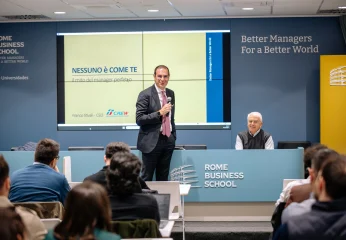
In today’s world, the Olympic Games have evolved far beyond a simple series of athletic competitions. They now represent a massive, sophisticated strategic ecosystem. During the session, Casassa outlined the “engine” driving the event—a rigorous six-year development cycle dedicated to seamless organization and global positioning.
As a private entity, Fondazione Milano Cortina 2026 operates under strict IOC obligations while balancing delicate relations between sports bodies and local administrations. “The focus isn’t just the final score,” Casassa noted. “It’s about creating the perfect conditions for athletes so that while thousands compete for excellence, billions can be truly inspired.”
Data-Driven Impact: Making History with the Most Balanced Games
The workshop also gave students a chance to analyze the real numbers defining the 2026 legacy. Moving past traditional vanity metrics, the committee highlighted a historic milestone: Milano Cortina 2026 is set to be the most gender-balanced Winter Edition in history, with female athletes making up 47% of the participants.
This commitment to excellence is matched by an impressive logistical scale. Spanning 22,000 km² across four distinct clusters, the event’s scope is captured by these key performance indicators:
- Global Talent: 2,900 athletes representing over 90 countries.
- Community Passion: 18,000 volunteer positions filled from a staggering 130,000 applications.
- Digital Reach: 900 competition hours specifically designed to meet 24/7 global digital demand.
The Five Pillars of Italian Identity: A New Storytelling Concept
One of the most engaging parts of the day focused on the “Great Beauty” of the Italian spirit. To overcome the usual limitations of traditional media, the Foundation developed a storytelling model built on five strategic pillars: Hospitality, Relation, Cuisine, Innovation, and Lifestyle.
Interestingly, this “Italian touch” is far more than just an aesthetic choice; it is deeply operational. For instance, the villages serve 220kg of pasta every day, turning our culinary heritage into a performance fuel. Meanwhile, global tech giants like Samsung and Technogym are fully integrated into the system, proving that “Made in Italy” is a premium commercial asset that adds real value to the Games.
Legacy & Sustainability: Impact Beyond the Medals
As the session drew to a close, the conversation shifted toward Sustainability and Legacy. Unlike many previous editions, Milano Cortina 2026 utilizes a “Human Rights Due Diligence” process. This ensures that social inclusion and climate mitigation aren’t just buzzwords, but a core part of the event’s ROI. Programs like Gen26 and Italia dei Giochi are already at work, ensuring the Games leave a meaningful, lasting mark on the country.
Where Global Vision Meets Leadership
Ultimately, having leaders like Luca Casassa on campus reinforces RBS’s position as Italy’s most international educational hub. By moving beyond a “visibility-only” mindset, the school provides students with the leadership tools they need for the real world. Here, academic theory meets the boardroom, teaching future managers how to navigate an industry where data-driven strategy and emotional resonance go hand in hand.