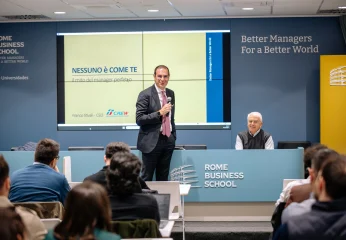
During the Build Workshop organized by the Career Services of Rome Business School and led by Alessandro Marangi, Global Senior Talent Acquisition Partner at General Electric, the students explored what truly makes a CV effective in today’s global job market. With experience gained at Microsoft, McKinsey and GE, Marangi explained that a CV is no longer a static document—it is a personal marketing tool designed to communicate value clearly, align with a specific employer, and secure an interview.
The biggest mistake candidates make is including every experience they’ve had. A recruiter—human or ATS—performs a first, rapid screening, where clarity and relevance matter more than quantity.
Marangi highlighted three essential elements:
A strong CV does not need to be perfect. It needs to be readable, consistent, and relevant for the position you are targeting.
There is no such thing as a universal CV. Every company has its own culture, language, and expectations. This is why tailoring your CV to the job description dramatically increases your chances of passing the screening.
You don’t need to rewrite the entire document every time—adjusting the summary and keywords is often enough.
The goal is not to look “perfect.” The goal is to look appropriate for that specific role.
Many candidates fail not because they lack skills, but because those skills don’t emerge clearly in relation to what the employer needs.
Marangi emphasized that CVs longer than two pages—especially with excessive graphics—tend to harm rather than help. Recruiters need clarity, not decoration.
Ideal structure (for most profiles):
Short bullet points, concrete data, and metrics whenever possible. No long paragraphs and no visual clutter.
The CV opens the door; the interview confirms the story you’ve told. Candidates who advance typically demonstrate:
Recruitment does not reward those who “sell themselves” aggressively, but those who communicate value clearly and authentically.
A CV is not bureaucracy: it is a strategic tool.
It doesn’t need to be perfect — it needs to be effective: targeted, customised, readable, intentional.
Just like a well-designed marketing campaign, an impactful CV is crafted by keeping three elements in balance: a clear target, a focused message, and a consistent positioning.
A CV does not tell who you are. It tells why they should choose you.