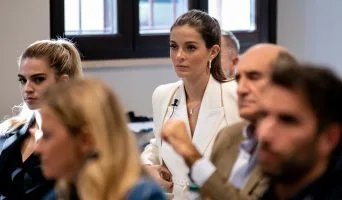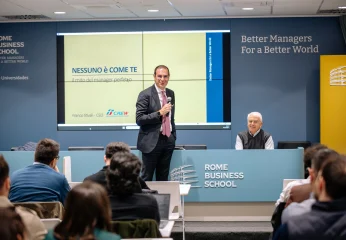
Building a workforce ready for tomorrow is one of the most critical challenges in today’s economy. Geopolitical, technological, and environmental disruptions are reshaping industries faster than ever. This theme took center stage during the Alumni Future Track, featuring Alessio Campi, P&C Director at Hays Italy, in an exclusive session for Rome Business School students.
Campi, an Environmental Engineer with a Ph.D. in Urban Planning and an expert in HR management, shared a clear vision: global change is an opportunity. Through data-driven insights, he illustrated how organizational success now depends on the synergy between technological innovation and human resilience.
The global workforce is undergoing a massive transformation. Research shows that 86% of employers expect AI to transform their business by 2030. However, digital access is not the only driver of change. Climate mitigation now ranks as a top trend, creating entirely new roles in renewables and environmental engineering.
These shifts have significant implications for skills. While the demand for cybersecurity and AI literacy is growing, “human skills” remain vital. Creativity, critical thinking, and resilience are now the most essential tools for navigating modern complexity.
A future-ready organization requires a total shift in mindset. According to the Hays Italia Salary Guide, skill shortages in digital and engineering roles are a major hurdle. To overcome this, Campi suggests moving toward a “Skills-First” approach.
Identifying present and future skills allows companies to enable internal mobility and targeted growth. Furthermore, organizations must build continuous learning ecosystems. Upskilling, mentoring, and microlearning are no longer optional but necessary for survival in a competitive market.
Technology should enhance, not replace, human contribution. Interestingly, many HR leaders feel that AI has not yet delivered real value. This gap suggests that organizations need better integration between people and automated tools.
Creating an agile culture is the solution: companies must prioritize flexibility, autonomy, and experimentation. This cultural shift is required to transform traditional hierarchies into dynamic, skills-based organizations that can adapt to market disruptions.
Modern managers must evolve to lead hybrid and multi-generational teams. The leadership of the future rests on data-driven decision-making and human-centricity. Managers must read trends and use data to plan resources effectively.
At the same time, empathy and psychological safety are fundamental: managers are now the primary talent developers. They must act as “perpetual transformers,” capable of aligning their teams with digital workflows while fostering a culture of trust and communication.
Attracting and retaining talent is the final frontier of modern HR. Today, candidates prioritize flexibility and well-being over salary alone, leaving organizations due to a lack of development and autonomy.
The roadmap is clear: start by identifying team capabilities and align development pathways with corporate strategy. By working closely with HR as strategic partners, leaders can turn a visionary workforce strategy into a successful reality.