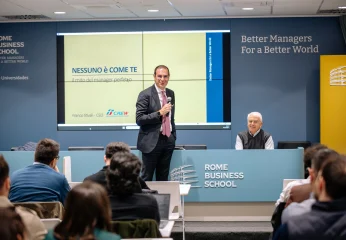
In today’s labor market, a career path is rarely a straight line. Consequently, managing a professional change requires more than just updated skills; it demands a strategic mindset. During the BPER Company Meeting held on January 23rd, career specialist Gabriele Sciulli explained how professionals can navigate these transitions with confidence by using his signature PCR Method (Promotion, Communication, and Relationship).
To begin with, it is essential to understand that a career transition is now an intentional shift. In fact, we have entered the era of Professional Innovation, where individuals are no longer passive subjects of market changes. Instead, to remain employable, every professional must actively manage three parallel pillars: their daily operational work, their personal brand, and their strategic network.
Furthermore, one of the most valuable insights from the meeting involves the Granovetter Theory. While we often rely on “Strong Ties” (family and close friends) for support, these connections rarely lead to career breakthroughs because they share our same social circle.
On the contrary, the real opportunities lie in “Weak Ties”, such as acquaintances or former colleagues. Because these connections act as bridges to unexplored markets, they are vital for growth. Therefore, the secret to effective networking is Strategic Reciprocity: by offering resources that cost us little but provide high value to others, we build a network that naturally fosters new opportunities.
Beyond high-level strategy, the success of a transition often depends on the quality of individual interactions. In this regard, Sciulli highlighted two key psychological tools to master during meetings or interviews:
In conclusion, the insights shared during the BPER Company Meeting prove that a career transition is not a hurdle to fear, but a strategic opportunity to seize. Ultimately, the difference between those who merely react to the market and those who lead it lies in the mastery of the PCR Method.
Therefore, do not wait for the next market shift to start building your future. Instead, begin today: audit your network, map your “Weak Ties,” and refine your personal brand. Because in the era of professional innovation, the best way to predict your future is to create it.
Are you ready to turn the uncertainty of change into your greatest competitive advantage? Join the next RBS initiative and start leading your transformation.