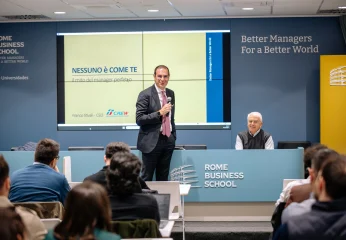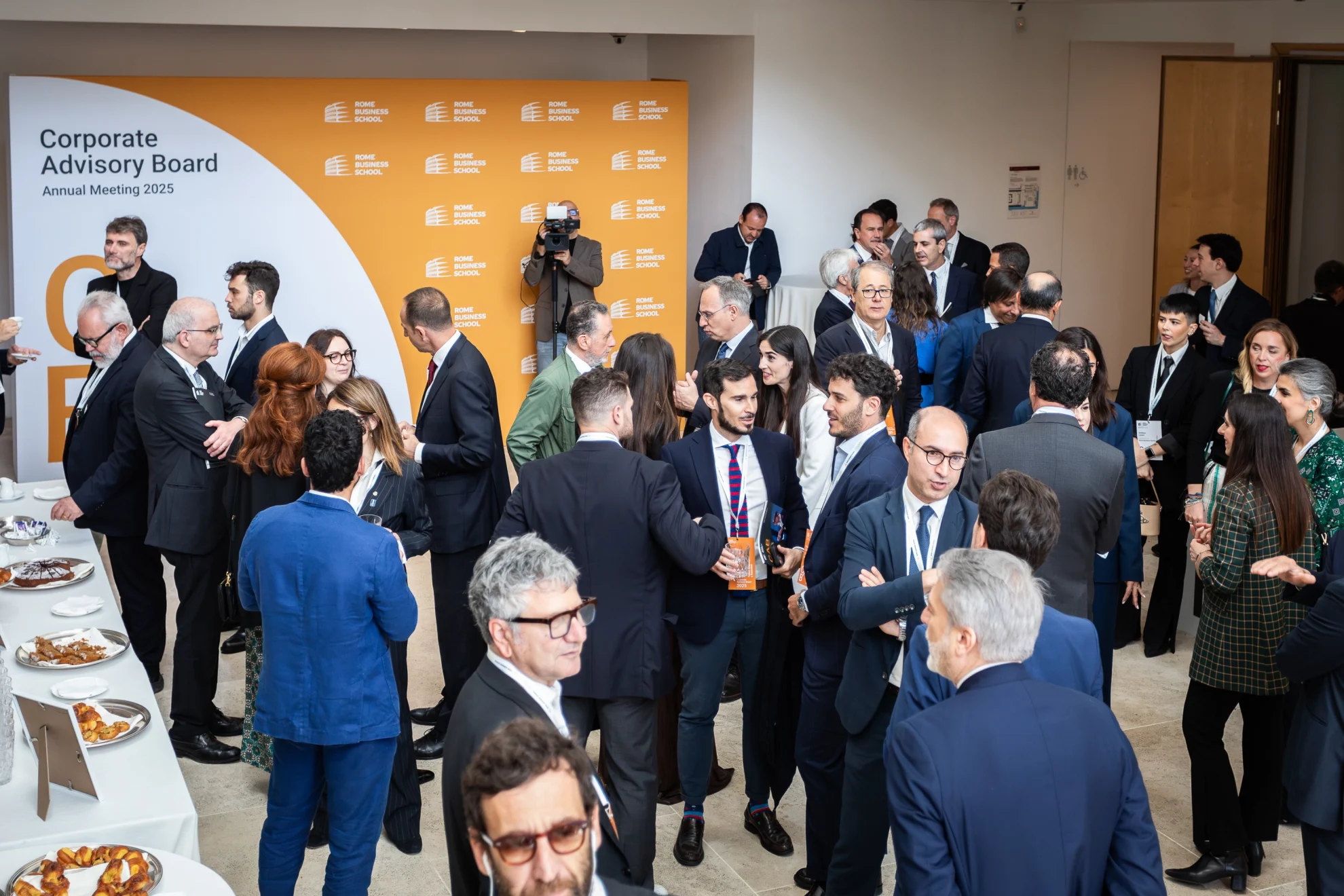
Tuesday, January 13, 2026. The Corporate Advisory Board (CAB) of Rome Business School welcomes 12 new members, further consolidating a community that now includes 137 top managers from companies such as Apple, Ferrero, and Gucci, operating across 17 industries and 8 functional areas. An ecosystem that has grown by 200% since 2020, the CAB continues to prove itself a strategic lever for innovation in academic programs, student employability, and structured dialogue with the business world.
The new members are: Danilo Belloni, Country General Manager Italy, Apple; Filippo Tomasoni, Head of Sales Azimut Grande EMEA-APAC, Azimut Yachts; Dianamaria Pacchioni, Head of Global B2C Customer Experience, Enel X; Daniele Carlone, Corporate Communications & Global Media Relations Manager, Ferrero; Barbara Pepponi, Director of Non-Life Insurance, Groupama Assicurazioni; Giovanni Perosino, Marketing Vice President, Gucci; Valerio Faccenda, Country Manager, Iberdrola; Marco Volpi, Director & Global Account Sales, Scalapay; Valeria Borrelli, Head of Organization and People, SIMEST; Giuseppe Suma, Group Vertical Director of Consumer, TikTok; Fabrizio Orlando, Global Director of Industry Affairs, Tripadvisor; Luca Conforti, HR Director, Valentino.
With the addition of 12 new members, the CAB further strengthens its seniority and sectoral diversity. At the same time, its international dimension continues to grow: over 70% of the represented companies operate globally, confirming Rome Business School’s international outlook and its ability to capture emerging trends, business models, and skills across key markets.
The CAB now presents an increasingly broad, cross-functional, and future-oriented configuration. It integrates traditional areas of expertise such as Operations & IT, Human Resources, and Finance—core managerial and industrial competencies—with strategic domains including startups and innovation, non-profit organizations, and future leaders under 30. This approach enables close attention to major economic and social transformations and enhances the interpretation of emerging trends.
Alongside the new members, the CAB and its activities continue to involve leading groups and global brands such as IBM, Microsoft, Heineken, and Amazon. These companies actively participate in thematic workshops, in-person meetings, and strategic discussions, often hosted at corporate headquarters in Rome and Milan. This network allows students to engage with real business cases, high-level decision makers, and concrete industrial scenarios, making the learning experience increasingly practical and future-oriented.
The year 2026 will mark a consolidation phase in the evolution of Rome Business School’s Corporate Advisory Board, with an increasingly structured collaboration model focused on the quality and impact of contributions. Attention will be directed toward targeted discussion formats designed to generate concrete insights that can be immediately transferred into academic design and the development of the educational offering.
Key new initiatives include formats such as the Industry Insights Lab, dedicated to gathering emerging signals, industry trends, and new business models directly from a managerial perspective, and the Future Newsroom, an intergenerational lab designed to foster dialogue between senior executives and future leaders on potential scenarios shaping key industries by 2030. Institutional moments of exchange will also be further strengthened, starting with the CAB Day, which will continue to represent the main occasion for synthesis and feedback on the work carried out throughout the year. The 2026 calendar will also include workshops hosted at corporate offices, building on successful past experiences and reaffirming the active role of companies in shaping educational content and engaging in dialogue with the business school.
“The Corporate Advisory Board is one of the pillars of our educational model,” comments Federica Salvatori, Associate Dean of Rome Business School. “The value of the CAB lies in the quality of dialogue and in the ability to structurally integrate the business perspective into our programs. It is this continuous exchange that allows us to keep our educational offering aligned with the evolving economic and professional landscape,” she concludes.
The Corporate Advisory Board is an integral part of Rome Business School’s educational model and represents one of the main drivers of alignment between academic training and the labor market. In 2025 alone, the CAB’s contribution resulted in 22 Business Practice Labs and 26 inspirational sessions. In terms of employability, 39 companies shared exclusive job opportunities, and 27 companies participated in the 2025 Career Fair, significantly strengthening the connection between classroom learning and the business world.
Beyond activities directly aimed at students, the CAB also has a substantial impact on the quality of the academic offering. Its members—managers and CEOs from companies such as Meta, Sony, and AstraZeneca—are involved in the planning, review, and coordination of Master’s programs. In 2025 alone, their contribution supported the improvement of 60 Master’s programs through the introduction of updated content, real business cases, practical exercises, and new modules dedicated to Artificial Intelligence, geopolitics, leadership, and sustainability.
This impact also extends directly to the faculty: 34 CAB managers are currently part of the Rome Business School teaching staff, 19 teach in Master’s programs, and 6 serve as Program Directors. A model that further strengthens the integration of managerial expertise with academic teaching.