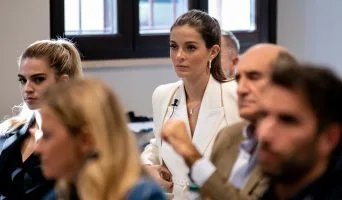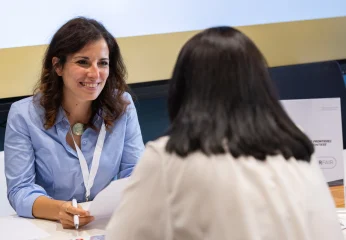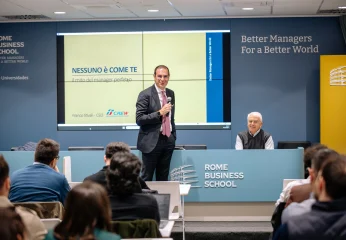
The discussion was led by Lucia Conte (Chief People & Organization Officer) and Ayla Romano (People & Organization Specialist). They outlined a working model based on adaptability, cross-functional skills, and a strategic reading of socio-economic changes.
A central theme was the evolution of professional trajectories. The experience shared highlighted how careers starting in seemingly distant fields, such as clinical psychology or social sciences, find full expression within People & Organization roles. In these contexts, analysis, active listening, and situational awareness become decisive assets.
In a labor market defined by frequent transitions and fluid specializations, value no longer lies in a linear path. Instead, it resides in the ability to integrate diverse expertise, transforming it into operational tools for modern organizations.
The keynote offered a concrete look at how organizations operate between strategic consultancy and impact design. Italiacamp works on territorial hubs, public-private partnerships, and programs that connect businesses, institutions, and communities. Within this framework, People functions play a key role: they do not just manage resources but build coherent cultures and foster constant dialogue with the academic world.
Significant attention was given to how HR strategies align with an organization’s overall vision. Talent acquisition, continuous learning, and role design are not treated as isolated processes. On the contrary, they are integrated elements of a broader strategy capable of sustaining innovation. Consequently, the People function becomes a strategic hub, interpreting labor shifts and translating them into sustainable organizational models.
The meeting underscored the importance of the relationship between enterprises and educational institutions. The exchange with RBS students reflects a vision where advanced training is essential for navigating complex, evolving environments. Furthermore, such experiences bridge the gap between the classroom and the workforce, offering a realistic view of the skills required today.
The final message is clear: work is no longer a rigid path, but a dynamic system of choices and continuous learning. Understanding its logic means closely observing organizations that design change by putting people at the center. This confrontation provided students with concrete tools to understand what it means to work in People & Organization functions and how to create value for the entire ecosystem.