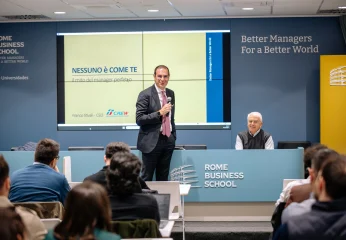
The contemporary fashion industry demands strong leaders. Specifically, it needs managers who can transform brand values into strategic assets. This was the central theme of a recent workshop at Rome Business School. The session was led by Caroline Diouf, HR Recruiter Specialist at Liu Jo.
Marco Marchi founded the brand in 1995. From the beginning, his vision was very clear: he wanted to celebrate female identity and promote empowerment. Today, Liu Jo is part of the Exide Group (Eccellenze Italiane). Consequently, it has become a leading international player in the premium contemporary segment. The company shows how to scale globally while staying connected to an original mission. In fact, they focus on enhancing authentic stories through strong synergies.
A core focus of the workshop was the brand’s organizational structure, which rests on three fundamental pillars.
Since 2019, Liu Jo has accelerated its commitment to the planet. They launched the “Fashion is Change” manifesto, a representation of conscious rethinking of their business model. Furthermore, it aims to integrate sustainability goals into long-term development.
Through the “Better Together” project, Liu Jo translates values into tangible actions. Caroline Diouf explained two key pillars during the session. For instance, Sustainable Retail focuses on energy efficiency and FSC-certified packaging. Moreover, Labor Ethics is guaranteed by the SA8000 certification. This international standard is an essential asset for modern managers, since it allows them to operate with integrity and transparency in global markets.
Thanks to this workshop, Rome Business School students learned how a corporate vision requires high-level skills. Management is not merely about design: instead, it is about managing complexity.
Future leaders must learn to interpret international certifications, as well as they must also oversee ethical supply chains. Therefore, Caroline Diouf’s testimony highlights the need for a specific education. This path combines creativity with managerial rigor. Ultimately, it prepares professionals to turn sustainability into a lasting competitive advantage.
In conclusion, the Liu Jo workshop confirms a new reality: success in fashion depends on uniting profit with social impact. Thanks to solid governance, the brand serves as a model of excellence. Management can indeed drive change: the industry is moving toward a more conscious and sustainable future.