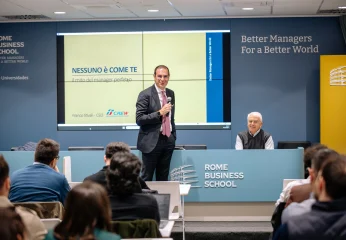
Jeans are far more than an iconic staple of global fashion—they are a cultural code that tells the story of revolutions, generational shifts and economic transformations. This was the core message of the Company Presentation held at Rome Business School, which welcomed Fabio Brunello, Vice President of Merchandise Planning & Inventory Management Europe at Levi Strauss & Co., for a session dedicated to the cultural, economic and social value of denim.
Part of the School’s practical initiatives connecting students with the business world, the event offered an exclusive perspective. It showed how a historic brand like Levi’s interprets identity, the market and innovation within a constantly evolving global industry.
Brunello guided students through a narrative intertwining history, pop culture and market dynamics. In the 1960s and 1970s, he explained, jeans became a universal language: no longer simple workwear, but a symbol of rebellion, autonomy and a desire for change.
Their popularity exploded across music festivals, artistic communities and the cities driving cultural revolutions—such as San Francisco. Denim became a marker of generational distinction, reshaping the visual and social codes of young people of the time.
One of the most powerful moments of the presentation concerned the political dimension of denim. During the Cold War, the Soviet Union banned and smuggled in jeans as coveted items symbolizing freedom. Brunello recalled how images of the fall of the Berlin Wall showed thousands of young people wearing denim: a spontaneous and powerful symbol of the desire to open up to the Western world.
From simple clothing, jeans became a uniform of progress—an unmistakable sign of social emancipation.
Today, denim continues to evolve, undergoing a transformation driven by technology, sustainability and new operational models.
Brunello highlighted how innovation is reshaping the entire value chain:
lower-impact production techniques
data-driven supply chains
more accurate predictive systems for managing global inventories
more agile and personalized merchandising models
This new phase may not carry the dramatic weight of historical events like the fall of the Berlin Wall, the VP noted, but it nevertheless marks a turning point for the industry—where creativity, technology and environmental responsibility are deeply intertwined.
The Levi’s Company Presentation fully aligns with Rome Business School’s mission: to offer students concrete, hands-on experiences connected to key players in the global economy.
Through its academic pathways—especially in fashion, retail, marketing and business management—the School promotes an integrated approach combining:
Understanding of cultural transformations
Critical reading of consumer trends
Mastery of supply chain and inventory planning
Awareness of sustainability and social responsibility
Brunello’s contribution allowed students to see how a historic brand maintains its relevance not just through products, but through the cultural impact it continues to generate.
A clear vision emerged from the event: fashion cannot be understood simply as a creative industry, but as a complex ecosystem. Culture, technology and society constantly influence one another.
Denim remains a catalyst for identity and change, while the new generation of professionals should interpret these signals with competence, clarity and critical thinking.
The Levi’s Company Presentation delivered a powerful message: turn passion into impact by combining strategic vision, analytical ability and cultural awareness.