Electric mobility, new business models, car sharing, soft skills, brand identity: today, a historic automotive group like Renault represents much more than a car manufacturer.
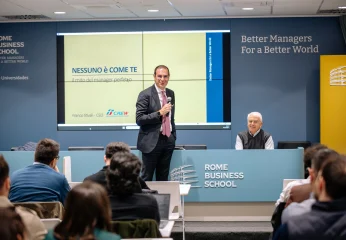
During a company presentation at Rome Business School, the Renault Group’s HR team—together with the Dacia business unit—offered students an insider view of how the sector is transforming and which opportunities are emerging for young professionals.
Renault is now an international organization with a widespread presence and a structured setup. In Italy, it employs around 550 people, mainly located in Rome—the national headquarters—Castel San Giovanni, the European logistics hub for spare parts distribution, and Milan, home to a business unit dedicated to the aftermarket. Alongside the Renault brand operate Sodicam Italia, focused on after-sales, and Mobilize Financial Services, which manages financing and leasing solutions.
The presentation also highlighted the brand’s historical journey in Italy—from its introduction in the 1950s to recent milestones, including record pre-pandemic sales and its leadership in the electric private-customer segment.
Energy and digital transitions are reshaping the automotive world. Electric vehicles—accelerated by the pandemic—are gaining central importance, along with onboard connectivity and integrated digital services. The relationship with the car is also changing: the vehicle is no longer only a possession, but a mobility tool to be used when needed. Car sharing, rentals, used cars, and flexible ownership models are redefining customer expectations and how companies generate value.
In this context, Renault has launched a strategic plan focused less on volume and more on quality, reorganizing brands and business units. The goal is to evolve into a technology-driven mobility company, not just an automaker.
The presentation emphasized the importance of people. In a complex and unpredictable context, competitiveness increasingly relies on soft skills: resilience, problem-solving, teamwork, and adaptability. This explains the group’s choice to encourage horizontal as well as vertical growth paths, with job rotation and role changes every few years to develop transversal competencies and a broader business perspective.
The internship selection process was also outlined, involving initial screening, introductory interviews, and an on-site assessment with group exercises, language and digital tests, and meetings with HR and managers. The goal: clear and timely feedback.
The second part of the session focused on Dacia as a concrete example of brand transformation. Today, the brand is no longer associated with low-cost positioning, but with value for money expressed through essentiality, robustness, and practicality. A streamlined product range, outdoor-oriented design, clear positioning, and a coherent visual identity have strengthened the brand’s presence in the private-customer segment, increasing market share and boosting demand for higher-end trims.
The initiative showcased how innovation, strategy, and corporate culture coexist within a sector often perceived as traditional. For students, it provided a valuable opportunity to understand the inner workings of the group, the role of transversal skills, and the future possibilities within a rapidly evolving market.