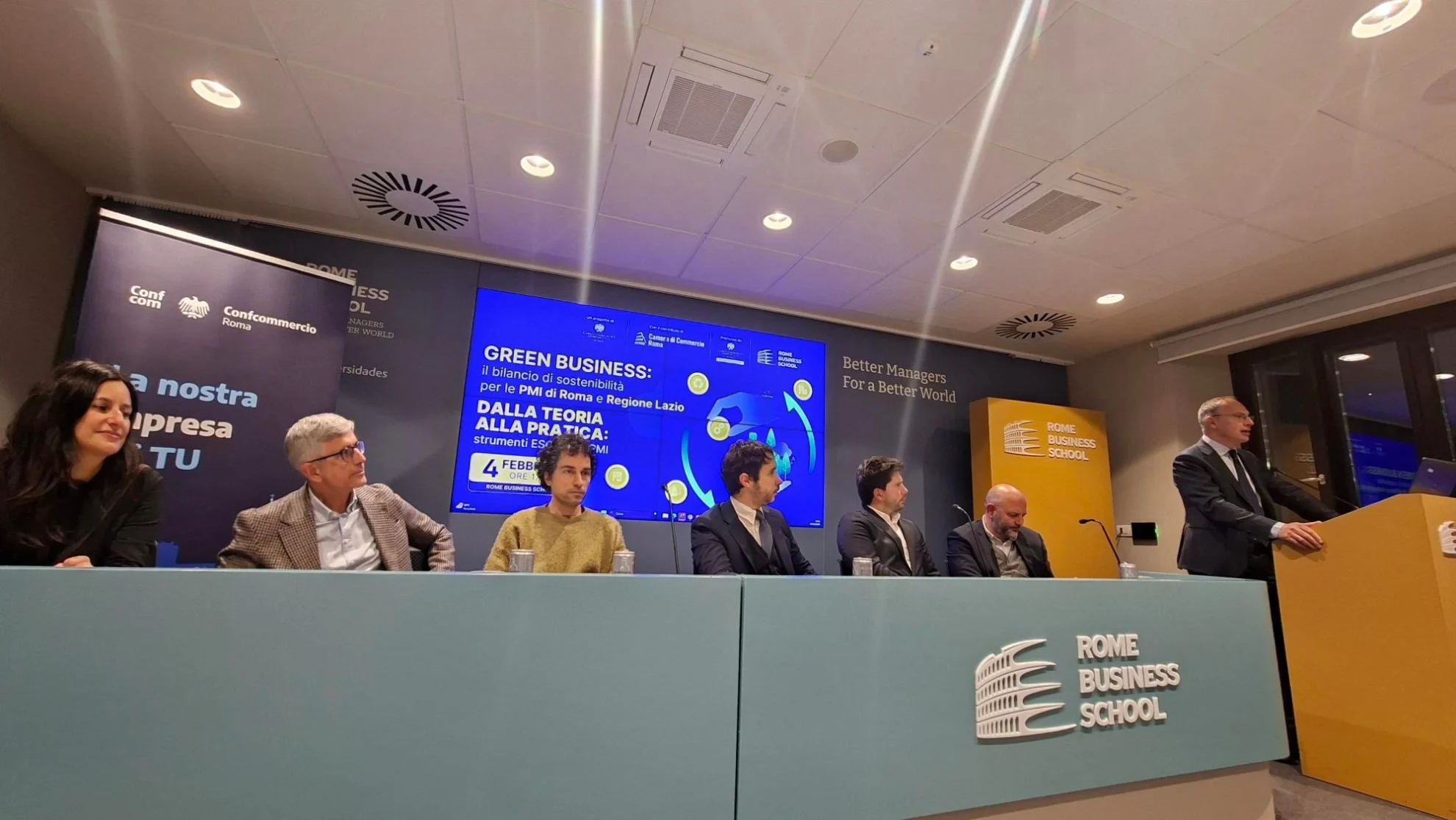
Moving from declared sustainability to applied sustainability. This was the core idea behind “Green Business: From Theory to Practice – ESG Tools for SMEs”, the event promoted by Confcommercio Rome – Young Entrepreneurs Group and hosted by Rome Business School. The initiative brought together businesses, experts, and academic representatives to explore how ESG criteria can become concrete tools for management and growth.
The event also marked the beginning of a more structured collaboration between the two organizations. This partnership was not simply about finding a venue, but about building a shared path capable of creating real value for the local business ecosystem.
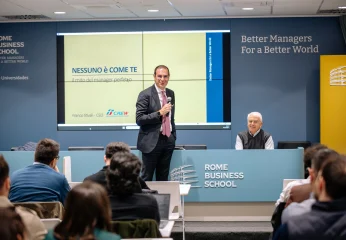
The event opened with remarks by Massimo Scarcello, Associate Dean of Rome Business School, who highlighted the key role of managerial education in supporting companies during an increasingly rapid phase of transformation. In this context, ESG criteria are no longer a niche topic. They are becoming a core element that influences organizational choices, governance models, and the ability of companies to engage with stakeholders and the financial system.
The discussion focused on a crucial goal: moving beyond a purely theoretical view of sustainability and treating it as an operational tool. ESG can guide strategic decisions and strengthen the competitiveness of small and medium-sized enterprises.
Speakers emphasized the need to translate principles into concrete actions, avoiding the risk of ESG remaining a purely declarative exercise. For companies in the service sector in particular, sustainability is increasingly a positioning factor and a key element in supply chain relationships.
One of the most significant moments of the debate concerned how companies measure performance. Luigi Corvo, Chief Executive Officer of Open Impact, invited participants to look beyond traditional financial indicators and focus on the broader effects generated by businesses.
Our impact is not just our revenue. There are dynamics that do not yet appear in financial statements but will affect the economic and social stability of our territories. Measuring them means having a compass to understand change, rather than being overwhelmed by it.
His contribution offered a broader reflection on the transformation of today’s economy. Topics included the decline of local commerce, the loss of young human capital, and the risk of recognizing change only when it becomes an emergency. In this scenario, impact measurement is not a theoretical exercise. It is a necessary condition for developing strategies that combine sustainability and long-term growth.
While ESG is increasingly central at a strategic level, its daily implementation raises practical challenges, especially for SMEs. This perspective was shared by Andrea Palombini, entrepreneur at the Palombini Group, a historic name in Roman hospitality. He highlighted how many business owners still see sustainability as a complex area, shaped by detailed regulations and indicators that are often difficult to interpret.
Today, the real issue is perspective. Many entrepreneurs see sustainability as a cost because they do not yet recognize its benefits. But with the right tools, what looks like a constraint can become a competitive advantage.
Through practical examples, from reducing plastic use to food recovery policies, the discussion showed that the real cultural shift lies in moving sustainability from obligation to strategy. For businesses deeply rooted in their communities, this also means redefining their role. They are no longer just service providers, but active players capable of creating relationships and shared value.
The relationship between companies and their social context was addressed by Andrea Fassi, Vice President of the Young Entrepreneurs Group of Confcommercio Rome. He focused on a less visible but decisive element: credibility.
Before strategy, there must be a strong ‘why’. Giving something back to the community is not a communication exercise. It is a responsibility. And this is what makes a business credible.
This approach goes beyond social impact initiatives. It reflects a way of understanding entrepreneurship as an integral part of community life. A perspective that strengthens reputation and trust, both of which are increasingly crucial for long-term competitiveness.
The roundtable discussion painted the picture of an evolving ecosystem. Trade associations, business schools, and companies are called to work together to support the transition toward more sustainable models. By hosting the event, Rome Business School confirmed its role as a platform for dialogue between managerial knowledge and entrepreneurial practice.
The initiative created a space where sustainability was addressed not as an ideological concept, but as a strategic infrastructure for growth. The key takeaway was clear: for small and medium-sized enterprises, ESG is no longer a future scenario. It is already a factor that directly affects competitiveness, access to resources, and market positioning.