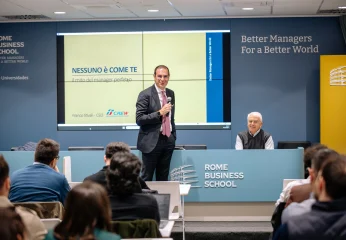
Professional football has become a truly global platform, where sport, marketing and commercial development are deeply interconnected. Mattia Sperotto, Global Commercial Development at AS Monaco Football Club, explored these dynamics and shared with students at Rome Business School an insider’s perspective on how an international club builds its positioning beyond the pitch. The session offered a concrete look at how football has evolved into a fully-fledged industry, where strategy, international relationships and brand value are just as crucial as on-field performance.
AS Monaco operates in a strongly international context, both by geographic nature and by strategic choice. Sperotto explained how commercial development requires constant analysis of global markets. The aim is of identifying strategic regions where the club can strengthen its presence and create new growth opportunities. This approach allows the club to move beyond the limits of domestic competition; AS Monaco becomes as an attractive partner for international sponsors seeking a sports project with a clear identity and a strong global outlook.
A key point of the discussion focused on the difference between working for a football club and operating within a federation. In the club environment, the focus is on a single entity, with a commercial and communication strategy built entirely around the club’s brand. In a federation, the logic changes significantly: multiple stakeholders must be coordinated, diverse interests aligned, and a system-wide vision developed. As Sperotto highlighted, this distinction has a major impact on market approach, partnership management and stakeholder relationships.
In modern football, sponsorships go far beyond simple on-pitch visibility. AS Monaco develops partnerships that integrate brand values, access to strategic markets and long-term project planning. The club’s premium positioning enables it to engage with companies looking not only for media exposure, but also for coherence, reputation and international activation capabilities. This requires skills that extend well beyond traditional marketing: market analysis, understanding partners’ needs and the ability to design tailored value propositions.
The experience shared during the session underscored how working in football means operating within a complex ecosystem, where communication, commercial activities, marketing and strategy must be perfectly aligned. Every decision impacts the brand, the relationship with fans and the club’s international credibility. For this reason, managerial skills and the ability to adapt to multicultural environments are increasingly essential for anyone aspiring to work in this sector.
The meeting allowed students to understand how professional football today is a space where passion and managerial discipline coexist. Through the example of AS Monaco, the transformation of sport into a platform for economic, relational and strategic development became clear—one where value is created far beyond the ninety minutes of play.