Rome Business School’s Employment Report published:
Tuesday, February 10, 2026. Salaries grew by an average of +38.14% for Rome Business School students. There are 1,515 students placed, over 1,000 active partner companies, and 72% of graduates employed in multinationals. These numbers define the real impact of RBS education in the 2026 Employment Report.
The return on investment is evident in terms of economic impact: 81.2% of students recorded a salary increase after completing their Master. Among the programs that stand out for salary growth are the Masters in Finance (+52.87%), the MBA (+46.90%), the HR area (+31%), and Project Management (+43.36%). Junior profiles also saw a significant impact, with a salary growth of +32.59%, an increase of 7.59 percentage points compared to 2024.
The report also highlights that 70% of students changed at least one of their sector, role, or country. 90.6% of students took on greater responsibilities in their roles, 84.1% concretely applied the skills learned during the Master, and 80.9% expanded their professional network. Opportunities arise during the training path: 71.6% of students receive new job offers during the Master year, in a context that saw 8,084 job offers published in 2025, a growth of +2.41% compared to 2024.
The analysis of employment outcomes shows a progression that consolidates over time: 75.2% of students receive job offers within one year of graduation. Among junior profiles, 71.42% obtained permanent employment. For international students, the educational path often leads to a choice of continuity: 34.3% decided to stay and work in Italy.
The international nature of the RBS experience is also reflected in employment outcomes. 72% of graduates work in multinationals and 65.7% start their professional careers outside of Italy. This result is made possible by a network of over 1,000 partner companies active in recruiting and career development. Of these, more than 195 came to RBS to conduct recruitment activities. Internationality is further strengthened by an international faculty (34%) and collaborations with major companies such as EY, IBM, and Toyota, which help create a multicultural and market-oriented learning environment.
Rome Business School’s employability model is based on a structured path that adapts to each student’s professional life. Career Services support students from initial orientation to entry into the workforce, integrating a Study Skills Program and programs dedicated to developing soft and managerial skills, such as the Leadership Program and the InsightX Program.
During 2025, 8,084 job offers were published, an increase of +2.41% compared to 2024. In the same year, 195+ companies visited Rome Business School for recruiting activities, company presentations, and direct meetings with students, including Amazon, Valentino, and Nestlé. Career Services activities also include professional development workshops, individual career coaching, CV and cover letter reviews, interview preparation, and structured networking moments, as well as the possibility for students to choose personalized career paths.
The results are reflected in a 98% placement rate and 1,515 placements made in 2025, a growth of +23% compared to the previous year. This outcome is possible thanks to a model that supports students in developing sector-specific skills and accessing qualified professional opportunities. To complete this path, the Career Fairs saw Rome Business School organize the largest Career Fair by a private business school in Italy for the second consecutive year, with over 100 companies per edition.
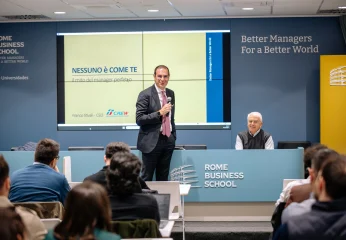
“In a labor market marked by uncertainty, technological transformation, and new professional models, employability is not just about finding a job, but about building adaptable, resilient, and future-ready careers. Our commitment is to accompany every student along this path with method, vision, and responsibility,” says Marco Regoli, Head of Career Services at Rome Business School.
Rome Business School is also a startup incubator, promoting entrepreneurship through the RBS4Entrepreneurship program. From 2021 to 2025, 25 startup ideas were developed, with the creation of over 470 MVPs (Minimum Viable Products) and the launch of 25 startups, generating over 510 jobs. Currently, 47% of the incubated startups are already active in the market with customers, confirming the program’s ability to accompany students from the ideation phase to concrete project validation.
Initiatives developed include AlaWayek, a female-led school transport platform; Gluck, which uses artificial intelligence to extract insights from satellite images; and TravelEase, a digital platform for accessibility in global tourism. Projects cover 21 markets and are active in 58 countries. A particularly relevant aspect is the strong female leadership, with 73% of female entrepreneurs holding leadership roles in the incubated startups.
The 2026 Employment Report, the result of analysis, study, and surveys of 660 respondents, highlights the value of a results-oriented educational model capable of transforming talent and ambition into concrete professional opportunities, both in Italy and internationally.
“The data also confirms what was already found in international rankings, such as the QS World University Ranking, which in 2025 ranked the Global MBA first in the world for career outcomes, proof of a concrete commitment to generating real impact for our students,” concludes Marco Regoli.