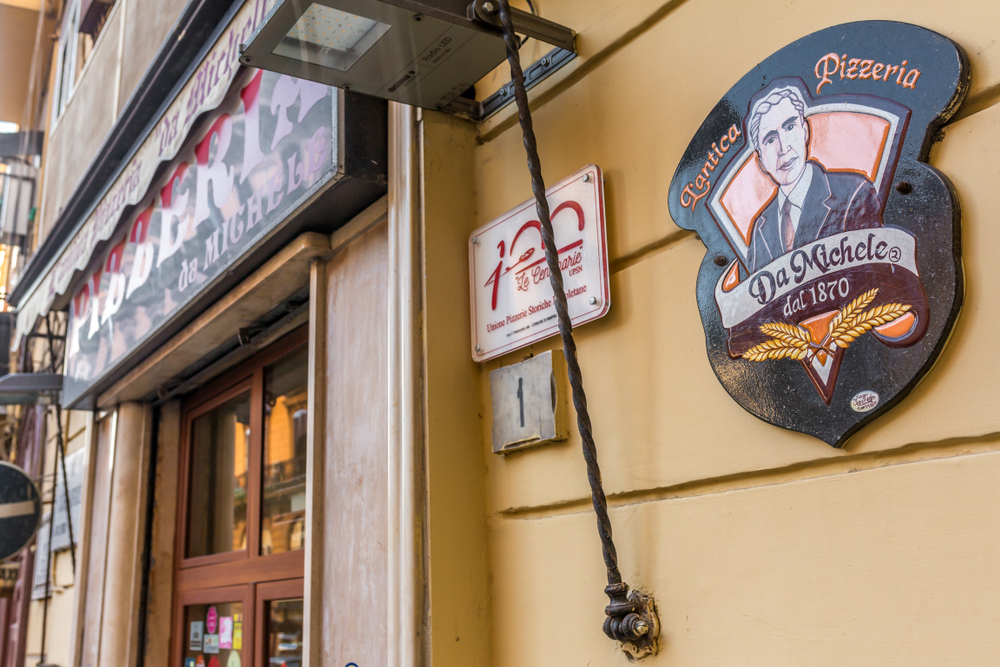
How can a traditional Neapolitan family business become a global brand while preserving its identity? This question stood at the heart of a company visit to Antica Pizzeria da Michele, which gave Rome Business School students the opportunity to explore international expansion, meet industry professionals, and experience the brand’s iconic product firsthand.
The experience began with an on-campus presentation, where students explored the history and growth of Antica Pizzeria da Michele. Emma Di Lorenzo, Communication Manager, and Alessandro Condurro, Managing Director and fifth-generation member of the family, shared their insights into the company’s development and the managerial challenges behind its international growth.
The experience then moved from the classroom to the pizzeria. Students had the chance to see the product up close and, most importantly, taste the pizza that has helped make Antica Pizzeria da Michele a globally recognised name.
Antica Pizzeria da Michele has built an international presence of more than 80 pizzerias across five continents. This growth raises a key challenge for any food and beverage brand: how can a company expand globally without losing the identity that made it successful in the first place?
International expansion requires more than entering new markets. Food retail brands must also deliver a consistent product and customer experience across different countries and cultures.
Several factors play a crucial role in this process:
For students studying Food and Beverage Management, this balance between standardisation and authenticity offers an important lesson. Successful international brands need scalable processes, but they must also protect the elements that make them distinctive.
The company visit also highlighted the strategic value of a clear and focused product offering.
In a highly competitive food and beverage market, brands often try to expand their menus to reach wider audiences. However, a strong focus on the core product can create a much clearer identity and strengthen brand positioning.
For Antica Pizzeria da Michele, iconic products such as Margherita and Marinara pizza remain at the centre of the brand experience. This focus allows the company to concentrate on quality while reinforcing the simplicity and authenticity that define its heritage.
The students explored three key strategic principles:
This approach shows that innovation does not always mean adding complexity. Sometimes, the most effective strategy involves protecting and strengthening what already makes a product unique.
The company visit offered students two complementary learning experiences.
The on-campus presentation introduced them to the history of Antica Pizzeria da Michele, its international growth journey, and the strategic decisions behind its expansion. Direct interaction with the company’s representatives also allowed students to discuss the challenges facing the food and beverage industry with professionals working in the field.
The experience then continued at the pizzeria, bringing the topics discussed in the classroom into a real business environment.
Students could observe the product firsthand and, most importantly, taste the pizza. This direct experience connected the strategic insights from the presentation with the product at the centre of the brand’s identity.
This combination of classroom learning and real-world exposure is a key element of Rome Business School’s company visits. Meeting companies and industry professionals helps students understand how the concepts they study translate into real business decisions.
Today, international food and beverage brands must also navigate a rapidly changing digital landscape. Technology can support brand reputation, transparency, customer engagement, and international positioning.
Antica Pizzeria da Michele has explored several innovative approaches to strengthen its brand and connect with new audiences.
These initiatives include:
These initiatives illustrate how a traditional food brand can explore new technologies and partnerships while maintaining a strong connection with its heritage.
Taking a business with deep local roots and turning it into an international brand requires a broad set of managerial skills.
Operational expertise remains essential, but international growth also requires professionals who can manage global supply chains, franchising models, strategic marketing, international markets, brand management, and cross-cultural business environments.
For future Food and Beverage managers, understanding these interconnected areas is essential. International expansion involves much more than opening new locations. It requires a clear strategy, strong processes, effective leadership, and the ability to protect a brand’s identity as it enters new markets.
The company visit to Antica Pizzeria da Michele gave Rome Business School students the opportunity to explore these challenges through a real-world business case. From the on-campus presentation to the final pizza tasting, the experience showed how a centuries-old Neapolitan tradition can evolve into a global food and beverage brand while remaining rooted in its original identity.
Would you like to develop the strategic skills needed to manage international expansion, brand strategy, and global food and beverage businesses?
Discover the International Master in Food and Beverage Management at Rome Business School and prepare to build your career in one of the world’s most dynamic industries.